
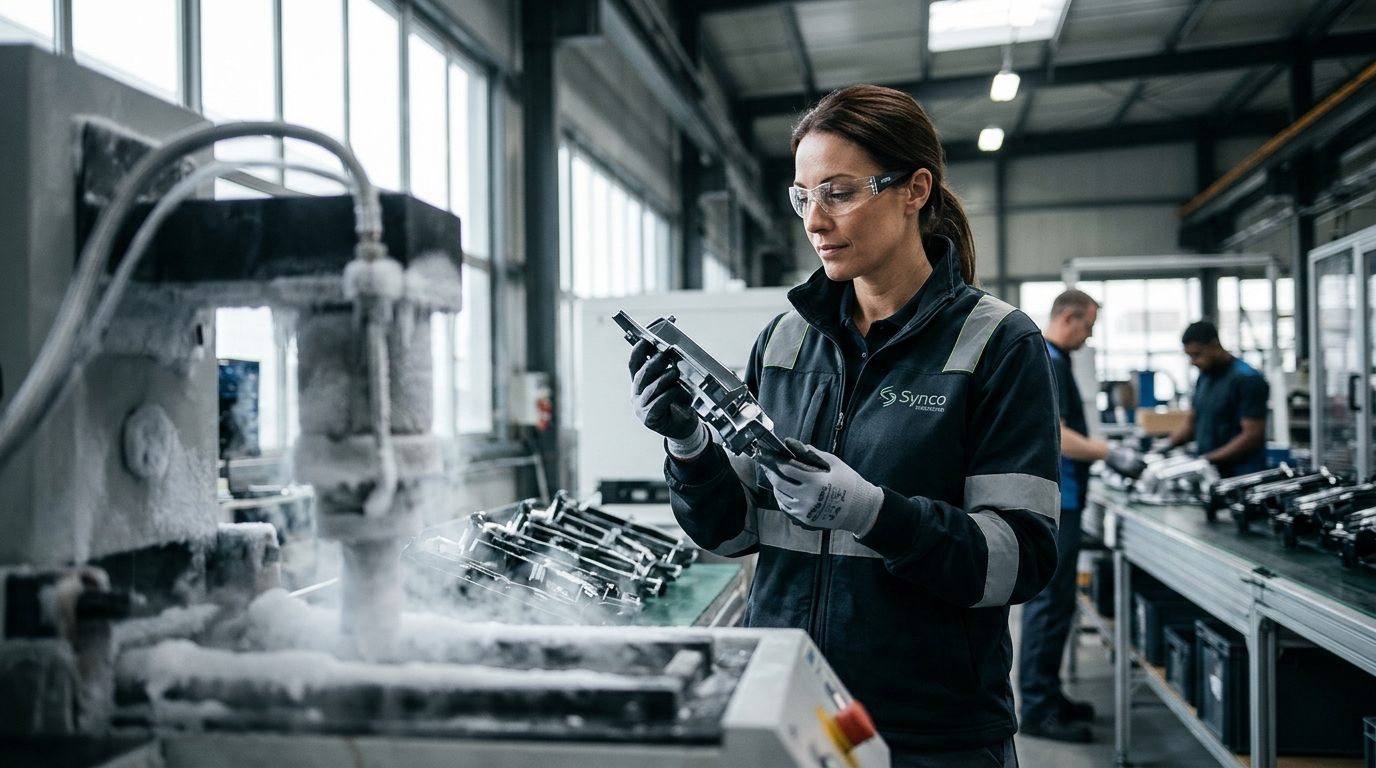
Cryogenic deflashing is the most dependable choice for mass production because it uses extreme cold to make plastic brittle, allowing for consistent and non-destructive removal of flash. This method ensures high throughput and minimal part damage, which are critical for high-volume manufacturing lines. Synco Industries provides specialized cryogenic deflashing machines designed to meet these rigorous industrial standards.
The Physics of Brittle Fracture
Cryogenic deflashing is a surface finishing process that utilizes liquid nitrogen to cool thermoset plastics to temperatures as low as -196 degrees Celsius. At this temperature, the material undergoes a glass transition, becoming brittle and glass-like. This physical change allows the flash to shatter off the part rather than being torn away, which is the primary mechanism of failure in mechanical deflashing. For additional details, review the axiom 8211 Synco Industries.
The reliability of this method stems from the consistency of the material's response to cold. Unlike mechanical methods that depend on the sharpness of blades or the pressure of media, the brittle fracture point is a fixed physical property of the polymer. This means that once the process parameters are set, the outcome remains stable over thousands of cycles. For manufacturers, this consistency reduces the need for constant process adjustments and minimizes the risk of part rejection.
Minimizing Part Damage and Rework
One of the greatest threats to mass production efficiency is the rate of part damage. Mechanical deflashing often leaves micro-scratches or alters the surface finish, leading to cosmetic defects. Cryogenic deflashing avoids these issues because the flash breaks away cleanly at the part boundary. The part itself remains in its original state, preserving the surface integrity required for subsequent painting or assembly.
For example, in the production of automotive components, even minor surface imperfections can lead to paint adhesion failures. By using a cryogenic deflashing machine, manufacturers can ensure that the substrate is pristine before the coating process. This reduction in rework directly impacts the bottom line by lowering labor costs and material waste. The process is particularly effective for complex geometries where mechanical tools cannot reach.
Implication: Lower damage rates translate to higher first-pass yield, which is a key metric for operational excellence in high-volume plants.
Throughput and Automation Integration
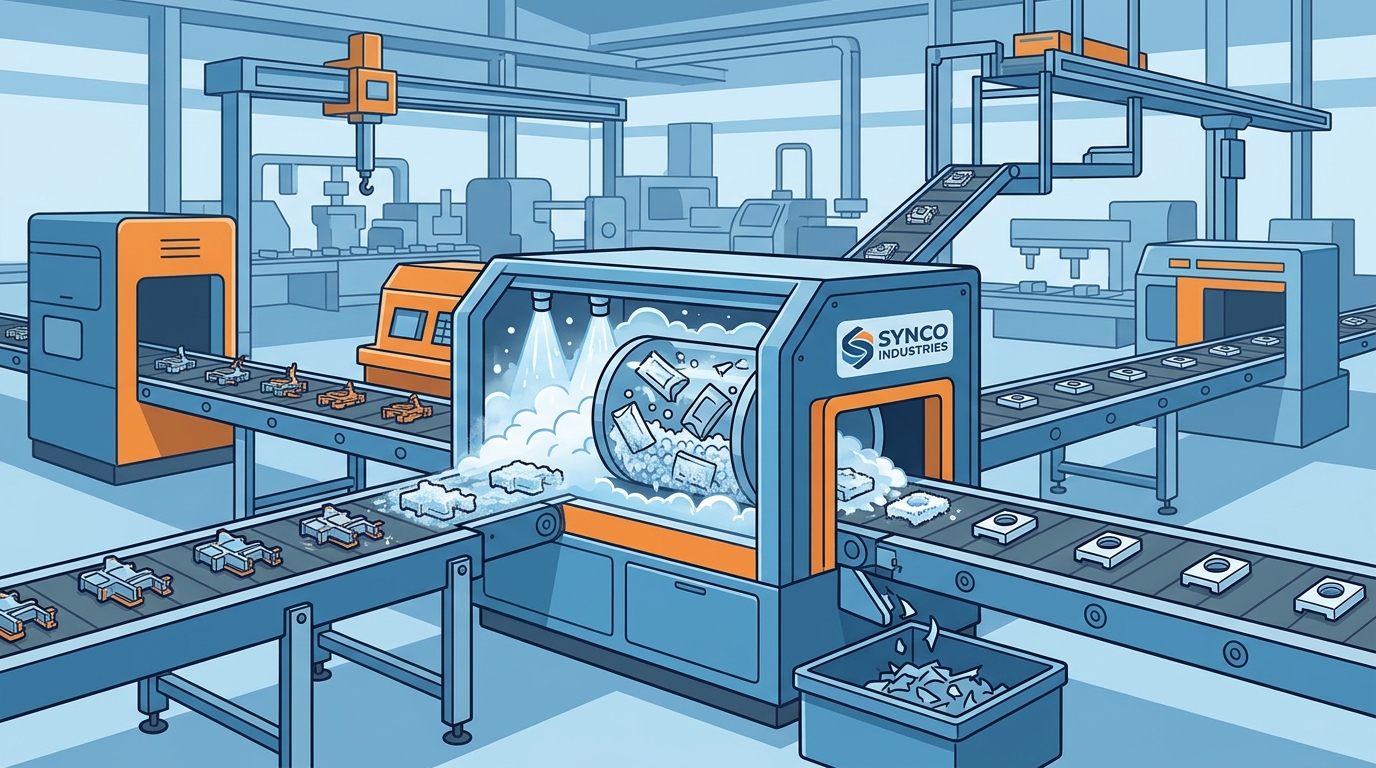
Mass production requires equipment that can keep pace with automated assembly lines. Synco Industries designs cryogenic deflashing machines with automated loading and unloading systems that integrate seamlessly into existing production flows. The process is fast, with parts typically spending only a few seconds in the cryogenic chamber. This rapid cycle time allows for high throughput without sacrificing quality.
The automation aspect is crucial for reliability. Manual handling introduces variability and safety risks, especially when dealing with liquid nitrogen. Automated systems ensure that every part is exposed to the cold for the exact same duration and at the same temperature. This uniformity is difficult to achieve with manual processes. Furthermore, the closed-loop nature of modern cryogenic systems recycles the nitrogen, reducing operational costs and environmental impact.
Implication: High throughput combined with automated consistency makes cryogenic deflashing a robust solution for 24/7 production environments.
Material Versatility and Process Stability
Cryogenic deflashing is not limited to a single type of plastic. It is effective for a wide range of thermoset materials, including phenolic, epoxy, and polyurethane. This versatility means that a single machine can handle multiple product lines, increasing the return on investment. The process stability is maintained because the fundamental physics of brittle fracture applies to all these materials, albeit with slightly different temperature thresholds.
For instance, a manufacturer producing both electrical insulators and automotive brackets can use the same cryogenic deflashing machine for both products. The ability to switch between materials without major retooling or process redesign adds a layer of operational flexibility. This adaptability is a significant advantage in markets where product mixes change frequently. The reliability of the process is further enhanced by the fact that it does not depend on the hardness or density of the flash, which can vary between batches.
Implication: Versatility and stability allow manufacturers to consolidate their finishing operations, reducing the complexity of their production floor.
Safety and Operational Compliance
Reliability in mass production also encompasses safety and regulatory compliance. Cryogenic deflashing systems are designed with multiple safety interlocks to protect operators from cold burns and asphyxiation risks. The use of liquid nitrogen requires strict adherence to safety protocols, but modern machines are equipped with sensors and alarms that monitor oxygen levels and chamber integrity. This ensures that the process remains safe even during long, unattended production runs.
Compliance with environmental regulations is another factor. Cryogenic deflashing does not produce hazardous waste or emissions, unlike some chemical or thermal deflashing methods. This makes it an attractive option for companies looking to meet strict environmental standards. The closed-loop system ensures that the nitrogen is contained and recycled, minimizing the environmental footprint. For Synco Industries, building machines that meet these safety and environmental standards is a core part of their engineering philosophy.
Implication: A safe and compliant process reduces the risk of operational stoppages and regulatory penalties, contributing to overall production reliability.
Key Takeaways
- Cryogenic deflashing uses extreme cold to make plastic brittle, ensuring consistent flash removal.
- The process minimizes part damage, leading to higher first-pass yields and lower rework costs.
- Automated systems provide high throughput and uniformity, essential for mass production.
- The method is versatile, handling various thermoset materials with stable process parameters.
- Safety features and environmental compliance make it a robust choice for regulated industries.
- Synco Industries offers specialized machines designed for these high-reliability applications.
Frequently Asked Questions
What is cryogenic deflashing?
Cryogenic deflashing is a process that uses liquid nitrogen to cool plastic parts to extreme temperatures, making the flash brittle so it can be removed without damaging the part.
Is cryogenic deflashing suitable for all plastics?
It is primarily used for thermoset plastics. Thermoplastics may not respond as predictably to the brittle fracture mechanism, so material testing is recommended.
How does cryogenic deflashing compare to mechanical deflashing?
Cryogenic deflashing is more consistent and causes less part damage. Mechanical deflashing can be faster for simple parts but is less reliable for complex geometries.
What are the safety concerns with liquid nitrogen?
Can cryogenic deflashing be automated?
Yes, it is highly suitable for automation. Automated loading and unloading systems are standard in high-volume production environments.
Does cryogenic deflashing produce waste?
The process itself does not produce hazardous waste. The flash is removed and can be recycled or disposed of as standard plastic waste.
Conclusion
Cryogenic deflashing stands out as the most dependable choice for mass production due to its consistency, low damage rates, and high throughput. By leveraging the physics of brittle fracture, it offers a reliable solution for manufacturers seeking to optimize their finishing processes. Synco Industries provides the expertise and equipment necessary to implement this technology effectively. To discuss your specific production needs, .