

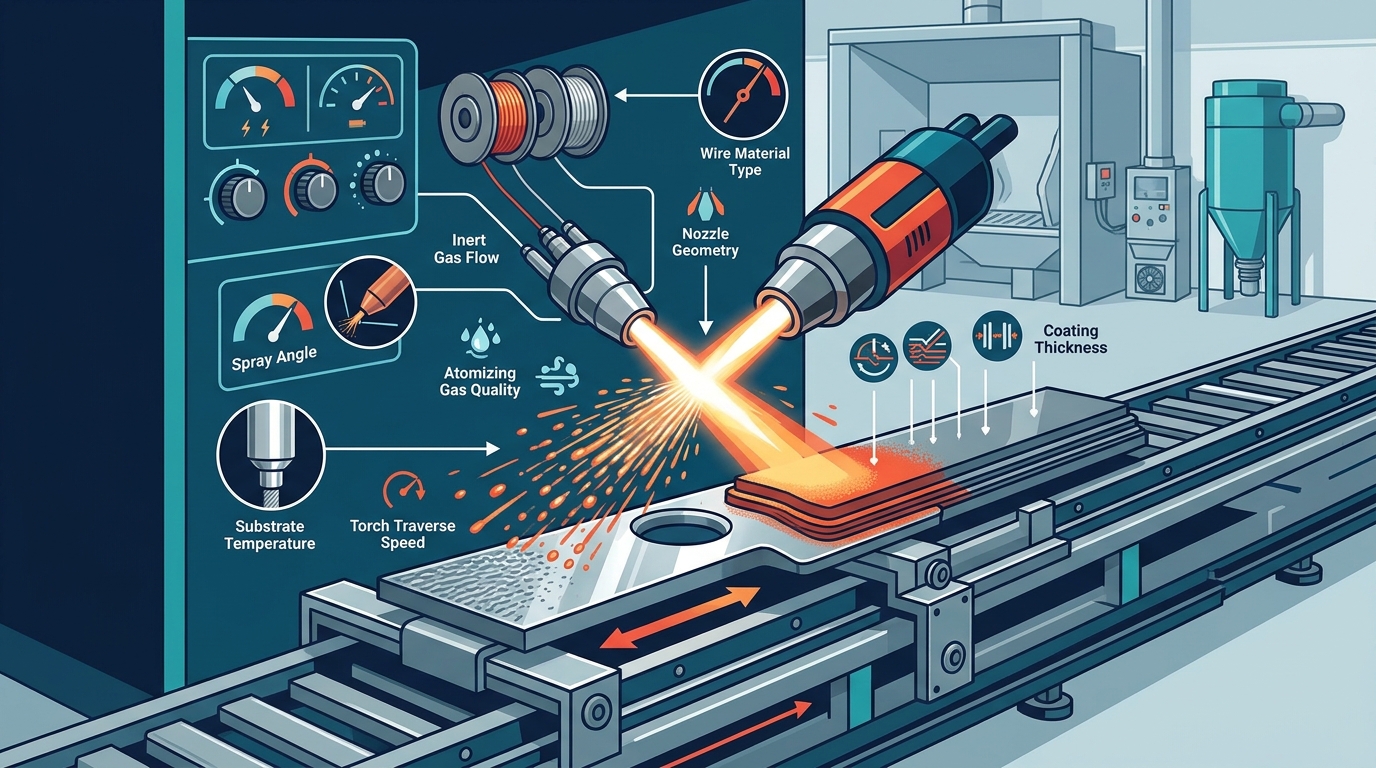
Arc spray deposition rate is the speed at which molten or semi-molten metal particles are transferred from a wire feedstock to a substrate surface. This metric is critical because it directly influences the thickness of the coating, the bond strength, and the overall durability of the finished component. Synco Industries, a leading manufacturer of thermal spray equipment in India, emphasizes that optimizing these rates is essential for achieving long-lasting protective coatings. Understanding the variables that control this process allows engineers to balance production speed with coating quality.
1. Wire Feed Speed and Tension
Consistent wire feed speed is the primary driver of deposition rate. The rate at which the wire is fed into the arc zone determines the volume of material available for atomization. If the feed speed is too low, the deposition rate drops, leading to thinner coatings that may not meet durability specifications. Conversely, excessive feed speed can cause unstable arcs and poor atomization, resulting in porous coatings. Maintaining precise tension and feed consistency ensures a steady stream of particles, which is vital for uniform thickness.
2. Arc Current and Voltage Settings
Optimal electrical parameters maximize the melting efficiency of the wire. The arc current and voltage settings control the temperature of the arc zone, which dictates how quickly the wire melts. Higher currents generally increase the melting rate, thereby boosting the deposition rate. However, if the voltage is not adjusted in tandem with the current, the arc length can become unstable. This instability leads to inconsistent particle velocity and temperature, which negatively impacts the coating's density and adhesion. Synco Industries designs its twin wire arc spray systems with precise control panels to help operators fine-tune these electrical parameters for specific alloys.
3. Spray Distance and Angle
The distance and angle between the nozzle and substrate affect particle impact energy. Spraying at the correct distance ensures that particles retain enough kinetic energy to deform and bond upon impact. If the nozzle is too far, particles cool and lose velocity, leading to a lower effective deposition rate and weaker bonds. If it is too close, the heat input can be excessive, causing substrate damage or spatter. The angle of incidence is equally important; spraying at a 90-degree angle maximizes the transfer efficiency. Deviating from this angle reduces the number of particles that successfully adhere to the surface.
4. Wire Diameter and Material Composition
Wire diameter and alloy composition influence the thermal mass and melting behavior. Thicker wires require more energy to melt, which can lower the deposition rate if the arc power is not sufficient. The composition of the wire, such as the addition of alloying elements, also affects its melting point and fluidity. For example, thermal spray powders and wires with specific alloy structures may require different arc settings to achieve optimal deposition. Understanding the thermal properties of the specific wire being used is crucial for predicting and controlling the deposition rate.
5. Substrate Preheating and Surface Preparation
Proper substrate preparation ensures strong bond strength and efficient particle adhesion. While preheating does not directly change the arc spray deposition rate, it significantly affects the quality of the deposited layer. A preheated substrate reduces thermal shock, allowing particles to flatten and bond more effectively. Surface preparation, such as shot blasting, creates a roughened surface that increases the mechanical interlocking of the coating. Synco Industries offers a range of shot blasting machines that are often used in conjunction with thermal spray systems to prepare substrates. This integrated approach ensures that the deposition process starts with a clean, roughened surface, maximizing the durability of the final coating.
6. Gas Flow Rate and Type
The shielding gas flow rate and type protect the arc and influence particle velocity. In arc spray processes, a shielding gas is often used to protect the molten particles from oxidation. The flow rate of this gas affects the velocity of the particles as they travel to the substrate. Higher gas flow rates can increase particle velocity, which improves the impact energy and bond strength. However, excessive gas flow can also cool the particles too quickly, reducing their ability to deform and bond. The type of gas used, such as argon or nitrogen, also plays a role in the thermal properties of the arc and the resulting coating.
7. Equipment Maintenance and Nozzle Condition
Regular maintenance of the spray gun and nozzles ensures consistent performance. Wear and tear on the nozzles and contact tips can alter the arc geometry and stability, leading to fluctuations in the deposition rate. Clogged or worn nozzles can cause uneven wire feeding and arc instability. Regular inspection and replacement of consumable parts are essential for maintaining consistent deposition rates over time. Synco Industries provides spares for their thermal spray equipment, ensuring that operators can maintain their systems with high-quality components. This proactive maintenance approach helps prevent downtime and ensures that the coating process remains efficient and reliable.
Choosing the Right Factors for Your Application
When selecting the optimal settings for your arc spray process, prioritize the specific requirements of your application. For high-durability coatings, focus on achieving high particle velocity and strong bond strength, even if it means a slightly lower deposition rate. For high-volume production, balance the deposition rate with coating quality to ensure efficiency. By understanding and controlling these seven key factors, you can optimize your arc spray process for both speed and durability.
Frequently Asked Questions
What is the ideal deposition rate for arc spray coatings?
The ideal deposition rate depends on the specific application and the required coating thickness. Generally, a deposition rate of 1 to 3 kg/hour is common for many industrial applications. However, for high-durability coatings, a lower rate with higher particle velocity may be preferred to ensure strong bond strength.
How does wire diameter affect the deposition rate?
Wire diameter affects the deposition rate by influencing the thermal mass of the wire. Thicker wires require more energy to melt, which can lower the deposition rate if the arc power is not sufficient. Thinner wires melt more quickly, allowing for a higher deposition rate, but they may be more prone to breakage.
What is the role of substrate preheating in arc spray?
Substrate preheating does not directly affect the deposition rate, but it significantly improves the bond strength of the coating. A preheated substrate reduces thermal shock, allowing particles to flatten and bond more effectively. This results in a denser, more durable coating.
How often should arc spray nozzles be replaced?
The frequency of nozzle replacement depends on the usage and the type of wire being sprayed. As a general rule, nozzles should be inspected regularly and replaced when signs of wear or clogging are observed. Regular maintenance helps ensure consistent deposition rates and coating quality.
Can the deposition rate be increased without compromising coating quality?
Yes, by optimizing the arc current, voltage, and gas flow rate, it is possible to increase the deposition rate without compromising coating quality. However, it is important to find the balance between speed and quality, as excessive increases in deposition rate can lead to porous or weak coatings.
Conclusion
Optimizing arc spray deposition rates is a complex process that involves balancing multiple variables. By understanding the impact of wire feed speed, electrical parameters, spray distance, wire composition, substrate preparation, gas flow, and equipment maintenance, you can achieve the desired balance between speed and durability. Synco Industries provides the equipment and expertise needed to help you master these factors. To explore our range of thermal spray systems and find the right solution for your needs, .