

Arc spray voltage is the primary control variable that determines particle temperature, velocity, and coating density. Synco Industries engineers emphasize that mastering these electrical parameters is essential for producing durable, well-bonded metallic coatings. This guide outlines the seven critical voltage settings you must master to achieve consistent quality in twin wire arc spray applications.
1. Base Operating Voltage Range
Establish the manufacturer-recommended baseline for your specific wire alloy. The base voltage is the minimum electrical potential required to melt the wire feedstock consistently. For standard zinc and aluminum wires, this typically falls within a specific low-voltage band. Operating below this range results in unmelted particles and poor adhesion, while operating significantly above it can cause excessive spatter. Always start with the baseline provided in the wire datasheet.
2. Voltage-to-Wire Diameter Ratio
Adjust voltage proportionally to the thickness of the wire being used. Thicker wires require higher voltage to achieve the same melting rate as thinner wires. This ratio ensures that the arc energy is sufficient to fully liquefy the material before it enters the gas stream. Ignoring this relationship leads to inconsistent particle size and porous coatings. Synco Industries recommends recalibrating voltage whenever you switch wire gauges.
3. Voltage Stability and Fluctuation Limits
Maintain voltage stability within a narrow tolerance band to ensure uniform particle formation. Voltage fluctuation is the variation in electrical output over time. High fluctuation causes erratic melting, resulting in a mix of fully melted and partially melted particles. This inconsistency directly impacts coating porosity and bond strength. A stable power supply is critical for high-quality industrial coatings.
4. Peak Voltage for High-Conductivity Wires
Optimize peak voltage settings for wires with high electrical conductivity. Materials like copper and certain stainless steels conduct electricity differently than zinc or aluminum. These high-conductivity wires often require specific peak voltage adjustments to maintain a stable arc. Without proper tuning, the arc may drift or extinguish, leading to process interruptions. Fine-tuning the peak voltage ensures continuous, stable spraying.
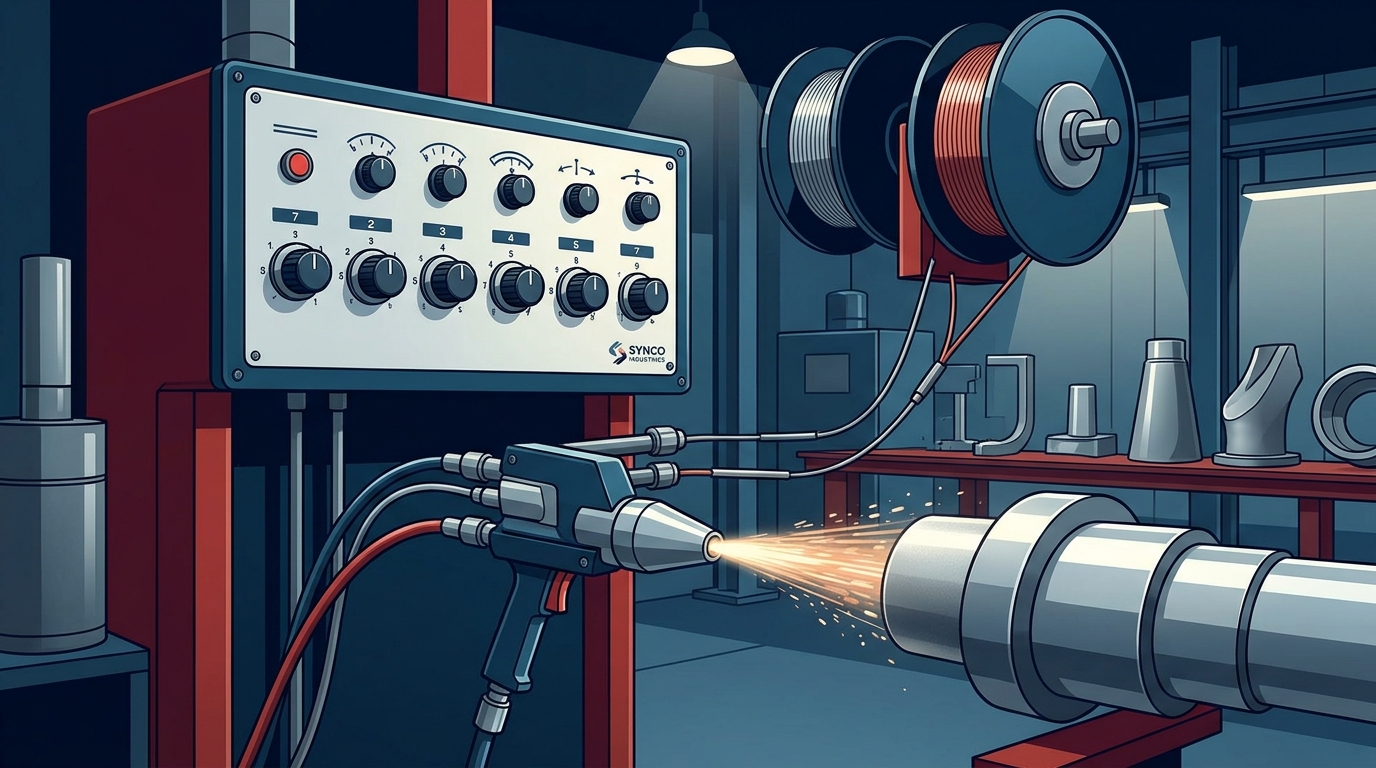
5. Voltage Compensation for Gas Flow Interaction
Balance voltage settings with gas flow rates to control particle velocity. The interaction between the arc voltage and the carrier gas flow determines the final particle velocity. Higher voltage increases particle temperature, while gas flow dictates speed. An imbalance can result in particles that are too hot and slow, or cool and fast. This balance is crucial for achieving dense, well-bonded coatings on complex geometries.
6. Voltage Adjustment for Ambient Conditions
Modify voltage settings to compensate for environmental factors like humidity and temperature. Ambient conditions affect arc stability and wire melting efficiency. In high-humidity environments, the arc may require slightly higher voltage to maintain stability. Similarly, cold shop floors can affect wire feed consistency. Adjusting voltage for these conditions ensures that the coating process remains reliable regardless of the workshop environment.
7. Voltage Monitoring for Process Control
Implement real-time voltage monitoring to detect process deviations early. Continuous monitoring allows operators to identify when the voltage drifts outside the optimal range. This proactive approach prevents the production of defective coatings. Synco Industries integrates monitoring systems into their equipment to provide immediate feedback on electrical parameters. This data is vital for maintaining quality control in high-volume production.
Choosing the Right Voltage Setting
Select the voltage setting based on the specific wire alloy, diameter, and desired coating properties. Always begin with the manufacturer's baseline and adjust incrementally while monitoring particle behavior. For detailed equipment specifications and support, visit the Arc Spray System page at Synco Industries.
Frequently Asked Questions
What is the ideal voltage range for zinc arc spraying?
The ideal voltage range for zinc arc spraying typically falls between 30 and 40 volts, depending on the wire diameter and gas flow. This range ensures consistent melting and high deposition efficiency.
How does wire diameter affect voltage requirements?
Wire diameter directly impacts voltage requirements, as thicker wires need higher voltage to melt completely. Adjusting the voltage-to-diameter ratio is essential for maintaining consistent particle size and coating quality.
Why is voltage stability important in arc spraying?
Voltage stability is critical because fluctuations cause inconsistent melting and particle formation. Stable voltage ensures uniform particle temperature and velocity, leading to dense, well-bonded coatings.
Can ambient temperature affect arc spray voltage settings?
Yes, ambient temperature and humidity can affect arc stability and wire melting efficiency. Operators may need to adjust voltage slightly to compensate for these environmental factors and maintain process consistency.
How do I monitor voltage during the spraying process?
Use real-time monitoring systems integrated into the spray equipment to track voltage fluctuations. This allows for immediate adjustments and helps prevent the production of defective coatings.