
Cryogenic vs. Bakelite Deflashing: Best Method for Rubber Components
Industrial manufacturers face a critical decision when removing flash from rubber parts. The choice between cryogenic and Bakelite deflashing methods directly impacts production speed, surface finish quality, and overall operational costs. Recent industry data indicates that cryogenic processing has become the dominant standard for high-volume rubber manufacturing, capturing a significant share of the surface finishing market due to its ability to handle complex geometries without damaging delicate components. This shift reflects a broader industry move toward automation and consistent quality control in rubber component production. (Contact Us 8211 Synco)
Understanding the Cryogenic Deflashing Process
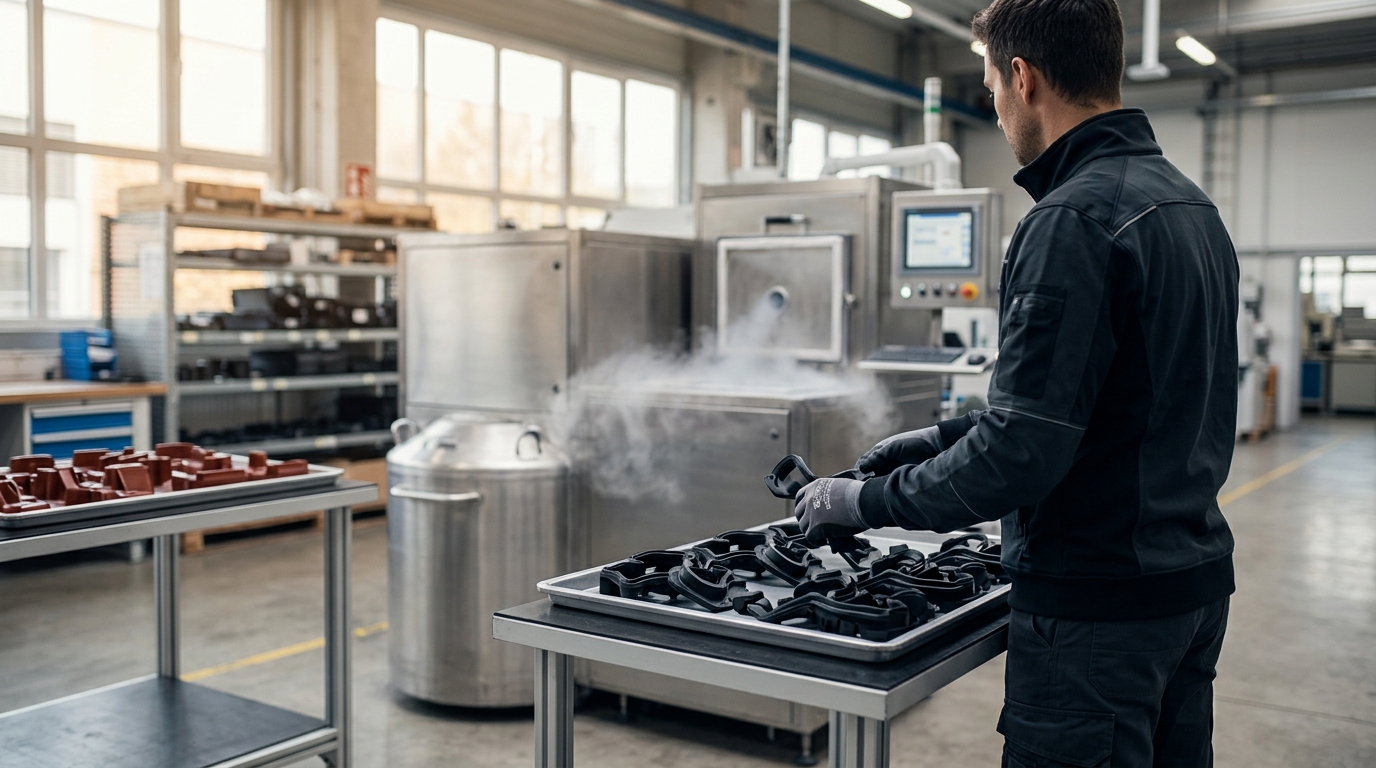
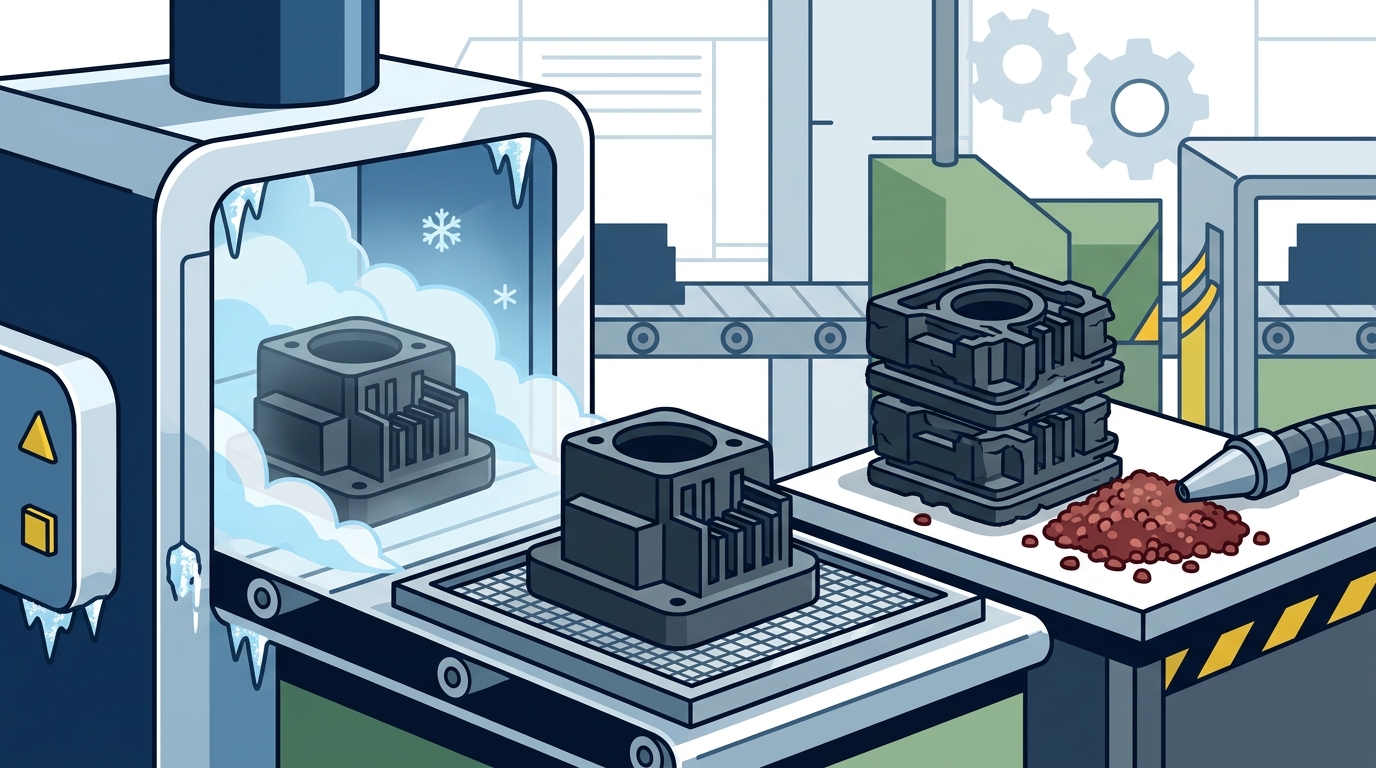
Cryogenic deflashing is a mechanical process that utilizes extremely low temperatures to alter the physical properties of rubber components. The core mechanism relies on the brittleness induced by liquid nitrogen or carbon dioxide. When rubber parts are exposed to these temperatures, they become hard and brittle. This transformation allows flash to be removed through mechanical impact without affecting the structural integrity of the main component. (About Us 8211 Synco)
The process typically involves three distinct stages. First, the parts are cooled to a temperature below their glass transition point. Second, the frozen parts are tumbled or blasted with media. Third, the brittle flash fractures off, leaving the flexible rubber intact. This method is particularly effective for intricate parts where manual trimming would be impossible or prohibitively expensive. (Synco Industries)
According to recent manufacturing efficiency reports, cryogenic systems can process hundreds of parts per cycle, significantly reducing labor costs associated with manual trimming. The consistency of the finish is another major advantage, as the process removes flash uniformly across all surfaces. This uniformity is critical for components that require precise dimensional tolerances.
For manufacturers seeking to understand the technical specifications of these systems, Synco Industries offers detailed information on their cryogenic deflashing machines. These systems are engineered to maintain consistent temperature control, ensuring repeatable results across large production batches.
The Bakelite Deflashing Approach
Bakelite deflashing, often referred to as drum deflashing or media tumbling, is a traditional mechanical method that predates widespread cryogenic adoption. In this process, rubber parts are placed in a rotating drum along with abrasive media, such as Bakelite pellets or plastic grit. The tumbling action causes the media to strike the parts, removing the flash through friction and impact.
The primary characteristic of Bakelite deflashing is its reliance on mechanical abrasion rather than thermal alteration. The media used is typically harder than the rubber flash but softer than the cured rubber component. This differential hardness allows the flash to be worn away while preserving the part's surface finish. However, this method requires careful selection of media size and density to avoid damaging delicate features.
While Bakelite deflashing is effective for simple geometries, it struggles with complex internal passages or thin walls. The media can become trapped in these areas, causing uneven wear or complete blockage. Additionally, the process generates significant dust and debris, requiring robust filtration and cleanup systems. This makes it less suitable for cleanroom environments or high-precision applications.
For a comprehensive overview of abrasive media options, including Bakelite and plastic grit, Synco Industries provides a range of high-purity abrasives designed for optimal deflashing performance. The choice of media directly influences the speed and quality of the deflashing process.
Comparing Efficiency and Cost
When evaluating cryogenic versus Bakelite deflashing, cost and efficiency are the primary decision drivers. Cryogenic systems have higher initial capital costs due to the complexity of the cooling and containment systems. However, they offer lower operational costs per part in high-volume scenarios. The automation potential of cryogenic deflashing reduces labor dependency, which is a significant factor in regions with high wage rates.
Bakelite deflashing systems are generally less expensive to purchase and install. They do not require liquid nitrogen or complex refrigeration units. However, the ongoing costs of media replacement and the higher labor requirements can make them less economical over time. The media wears down with use and must be regularly replenished, adding to the total cost of ownership.
The following table summarizes the key differences between the two methods:
| Feature | Cryogenic Deflashing | Bakelite Deflashing |
|---|---|---|
| Initial Investment | High | Low to Moderate |
| Operational Cost | Low (per part) | Moderate (media/labor) |
| Complex Geometries | Excellent | Poor |
| Surface Finish | Consistent | Variable |
| Environmental Impact | Low (closed loop) | High (dust/debris) |
Industry benchmarks suggest that for production runs exceeding 10,000 parts per month, cryogenic deflashing typically offers a faster return on investment. The speed of the cycle and the ability to automate loading and unloading contribute to this efficiency. For smaller batches or simpler parts, Bakelite deflashing may remain a viable option.
Material Suitability and Limitations
Not all rubber materials respond equally to deflashing methods. Cryogenic deflashing is suitable for a wide range of elastomers, including nitrile, silicone, EPDM, and fluorocarbon. The key factor is the material's glass transition temperature. If the rubber becomes too brittle at cryogenic temperatures, it may shatter rather than shed flash. This risk is higher with certain filled compounds or aged materials.
Bakelite deflashing is limited by the hardness of the rubber. Soft rubbers may be damaged by the abrasive media, while very hard rubbers may not shed flash effectively. The method is also less effective for parts with tight tolerances, as the media can cause dimensional changes. Manufacturers must test samples to determine the optimal media and tumbling time.
For specialized applications, Synco Industries offers customized deflashing solutions tailored to specific material properties. Their engineering team can advise on the best method based on your component's composition and geometry.
Synco Industries Deflashing Solutions
Synco Industries has been a leader in industrial surface finishing since 1982. The company specializes in manufacturing high-performance shot blasting machines, thermal spray equipment, and deflashing machines. With over 30 years of experience, Synco has served diverse industries including automotive, foundry, and structural steel.
Their cryogenic deflashing machines are designed for robust performance in demanding environments. The systems feature advanced temperature control and media circulation to ensure consistent results. Synco also provides a wide range of abrasives, including cut wire shots and plastic grit, to complement their machinery.
For clients requiring tailored solutions, Synco offers customized machine manufacturing. This service allows for modifications to standard designs to meet specific production needs. The company's commitment to quality is reflected in its ISO certification and CE compliance. Their global client base includes major organizations such as ISRO and the Indian Navy.
Learn more about Synco's engineering-driven approach by visiting the About Us page. The company's infrastructure includes advanced CNC machines and testing facilities to ensure precision in every unit.
Key Takeaways
- Cryogenic deflashing uses liquid nitrogen to make rubber brittle, allowing flash to be removed mechanically without damaging the part.
- Bakelite deflashing relies on tumbling parts with abrasive media, which is cost-effective for simple geometries but less precise for complex parts.
- Cryogenic systems offer superior consistency and automation potential, making them ideal for high-volume production runs.
- Synco Industries has been manufacturing deflashing solutions since 1982, serving over 1000 clients globally.
- The choice between methods depends on part complexity, material type, and production volume.
- Synco provides customized deflashing machines and a wide range of high-purity abrasives for optimal performance.
- Industry data indicates a shift toward cryogenic methods due to labor cost savings and quality consistency.
Frequently Asked Questions
What is the main difference between cryogenic and Bakelite deflashing?
Cryogenic deflashing uses extreme cold to make rubber brittle, while Bakelite deflashing uses mechanical abrasion from tumbling media to wear away flash.
Which method is better for complex rubber parts?
Cryogenic deflashing is generally better for complex parts because it removes flash uniformly without the risk of media getting trapped in internal passages.
Can Synco Industries provide customized deflashing machines?
Yes, Synco Industries offers tailored solutions designed to match specific industry applications and production needs, including customized machine manufacturing.
What types of rubber can be deflashed using cryogenic methods?
Cryogenic deflashing is suitable for nitrile, silicone, EPDM, and fluorocarbon rubbers, provided they do not become too brittle to shed flash effectively.
How does Synco Industries ensure quality in their machines?
Synco Industries ensures quality through robust quality control processes, third-party inspections, and ISO certification, with CE certified machines.
Is Bakelite deflashing still relevant in modern manufacturing?
Bakelite deflashing remains relevant for simple geometries and lower-volume production, but cryogenic methods are preferred for high-volume and complex parts.
What abrasives does Synco Industries supply?
Synco Industries supplies a wide range of abrasives, including cut wire shots, plastic grit, and metal powder, designed for optimal deflashing performance.
How long has Synco Industries been in business?
Synco Industries was established in 1982, bringing over 30 years of experience in industrial surface finishing and deflashing solutions.
Contact Synco Industries
Ready to optimize your rubber component production? Synco Industries provides expert guidance and high-performance deflashing solutions tailored to your needs. Contact their team today to discuss your specific requirements and receive a free quote.