
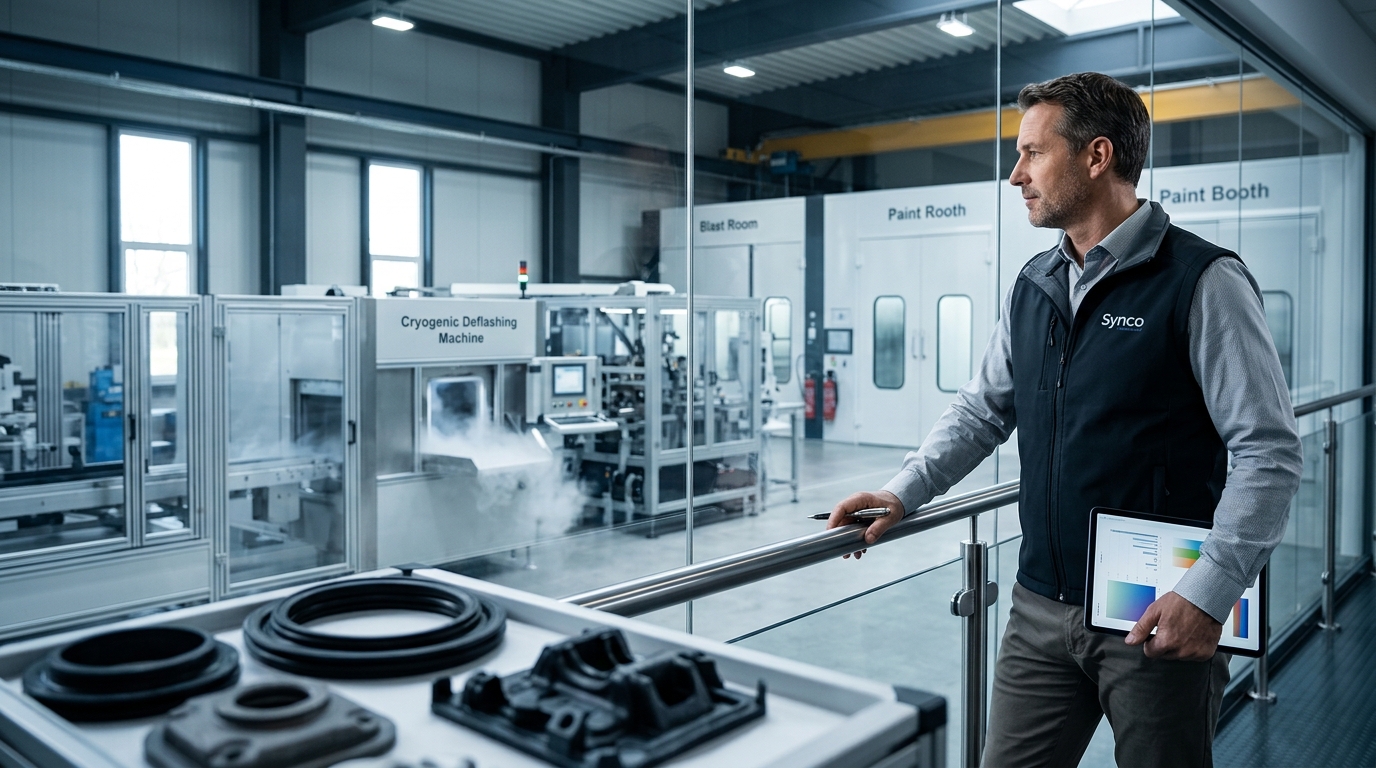
Cost-Benefit Analysis of Cryogenic Deflashing for Rubber Manufacturing
The global industrial deflashing market is undergoing a significant structural shift as manufacturers prioritize precision and environmental compliance over traditional mechanical methods. According to recent industry reports, the cryogenic deflashing segment is projected to grow at a compound annual rate exceeding 6 percent through 2030. This growth is driven by the increasing demand for high-tolerance rubber components in the automotive and aerospace sectors. For production managers, understanding the total cost of ownership is critical before transitioning from manual or mechanical deflashing to cryogenic solutions. (Contact Us 8211 Synco)
Understanding the Cryogenic Deflashing Mechanism
Cryogenic deflashing is a specialized surface finishing process that utilizes liquid nitrogen to embrittle rubber and plastic components. Liquid nitrogen boils at -196 degrees Celsius, providing the extreme cold necessary for this process. When rubber parts are submerged in this super-cooled environment, the flash or burrs become brittle and shatter upon impact with media, while the base material remains flexible and intact. (About Us 8211 Synco)
This method eliminates the need for manual trimming, which is labor-intensive and inconsistent. Synco Industries specializes in manufacturing high-performance cryogenic deflashing machines designed for consistent results and long operational life. Their systems are engineered to handle diverse industrial workflows, ensuring that manufacturers can achieve uniform cleaning and descaling across various material profiles. (About Us 8211 Synco)
Process Workflow
The process begins with loading the rubber components into the machine's chamber. Liquid nitrogen is then injected to lower the temperature rapidly. Once the target embrittlement temperature is reached, the machine agitates the parts with specialized media. The brittle flash breaks off, leaving a smooth, precise edge. The remaining media is separated from the parts, and the cycle repeats. (Synco Industries)
Direct and Indirect Cost Breakdown
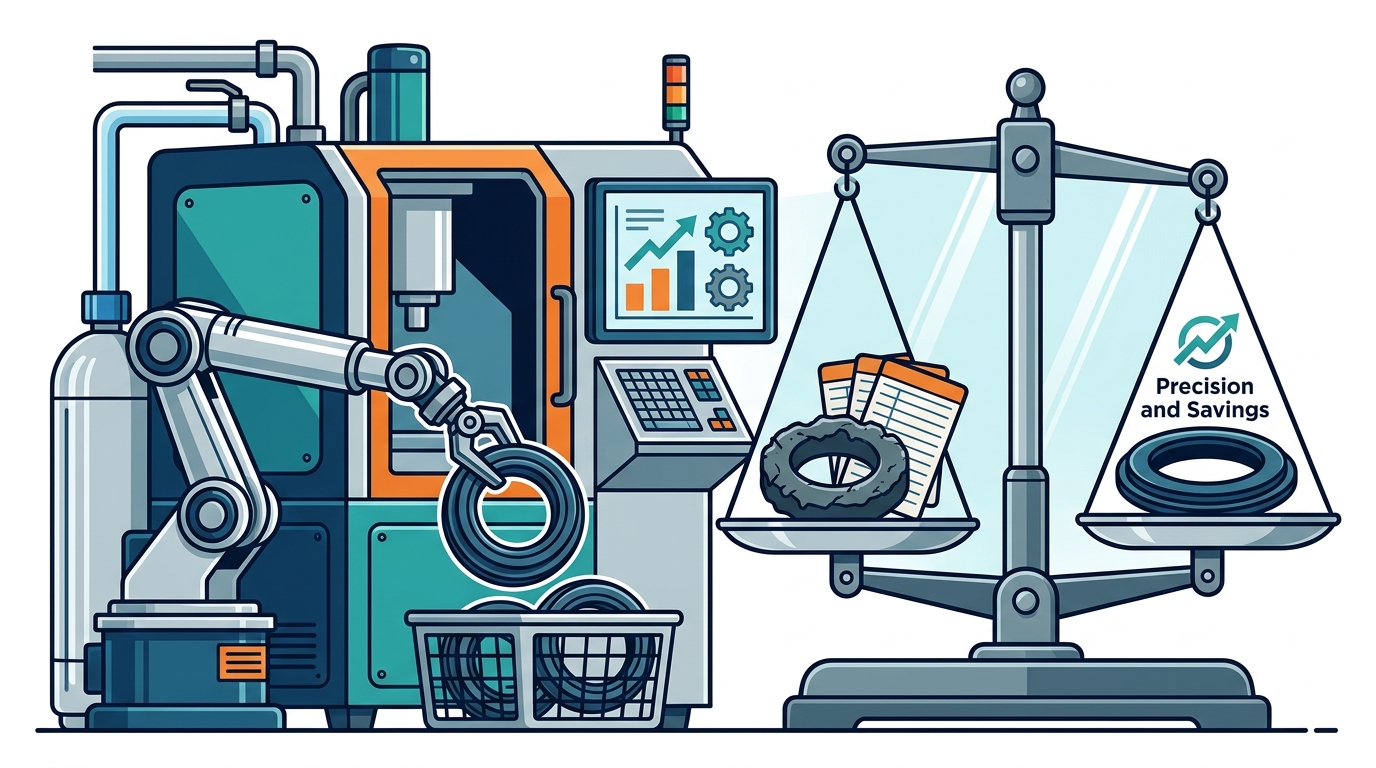
Evaluating the financial impact of cryogenic deflashing requires a detailed look at both capital expenditures (CapEx) and operational expenditures (OpEx). While the initial investment is higher than mechanical alternatives, the long-term savings are substantial.
Capital Expenditure (CapEx)
The primary cost is the purchase of the deflashing machine. Prices vary based on capacity, automation level, and customization needs. Synco Industries offers tailored shot blasting machines and deflashing solutions developed to match specific industry applications. Customized systems for high-volume production lines will command a premium but offer faster payback periods through increased throughput.
Operational Expenditure (OpEx)
Operational costs are dominated by the consumption of liquid nitrogen and electricity. Liquid nitrogen is a recurring cost, but its efficiency has improved significantly with modern machine designs. Studies in industrial cryogenics show that optimized cooling cycles can reduce nitrogen waste by up to 20 percent compared to older models. Additionally, maintenance costs are lower because there are no cutting blades or abrasive belts that require frequent replacement.
Quantifying Operational Benefits
The benefits of cryogenic deflashing extend beyond direct cost savings. They include improvements in quality, safety, and environmental compliance.
Quality and Precision
Cryogenic deflashing provides a superior surface finish compared to mechanical methods. It eliminates the risk of damaging the base material, which is common with tumbling or manual trimming. This precision is critical for rubber seals, gaskets, and automotive components where tolerances are tight. Synco Industries ensures consistent quality standards through strict quality control processes, ensuring every machine delivers uniform results.
Safety and Environmental Impact
Traditional deflashing methods often involve hazardous chemicals or noisy, dusty environments. Cryogenic deflashing is a clean process that generates no chemical waste. Liquid nitrogen is non-toxic and naturally evaporates, leaving no residue. This aligns with increasing regulatory pressures on industrial waste management. Environmental protection agencies increasingly mandate stricter controls on industrial solvent use, making cryogenic methods a future-proof investment.
Scalability
Cryogenic systems can be scaled to meet production demands. From small batch processing to continuous high-volume lines, the technology adapts to various needs. Synco Industries serves diverse industries including automotive, foundry, structural steel, heavy fabrication, and infrastructure, demonstrating the versatility of their equipment.
Comparative Analysis: Mechanical vs. Cryogenic
Understanding the differences between mechanical and cryogenic deflashing helps clarify the value proposition of each method.
| Feature | Cryogenic Deflashing | Mechanical Deflashing |
|---|---|---|
| Surface Finish | High precision, no damage | Variable, risk of scarring |
| Labor Cost | Low (automated) | High (manual or semi-auto) |
| Material Compatibility | Rubber, plastic, elastomers | Limited to hard materials |
| Environmental Impact | Low (no chemicals) | High (dust, noise, waste) |
| Initial Investment | High | Low to Moderate |
| Operational Complexity | Moderate (nitrogen supply) | Low (standard utilities) |
Calculating Return on Investment
The return on investment (ROI) for cryogenic deflashing is calculated by comparing the total cost of ownership against the savings from reduced labor and waste. For high-volume manufacturers, the payback period is typically 12 to 18 months.
Key factors influencing ROI include:
- Production Volume: Higher volumes accelerate savings through labor reduction.
- Part Complexity: Complex geometries benefit more from cryogenic precision.
- Labor Rates: Regions with higher labor costs see faster ROI.
- Quality Standards: Industries requiring zero-defect parts gain more value.
Synco Industries provides customized solutions tailored to your production needs, component size, material type, and throughput requirements. Their engineering-driven manufacturing ensures durability, accuracy, and optimal blasting efficiency.
Key Takeaways
- Cryogenic deflashing reduces labor costs by up to 80 percent compared to manual trimming.
- Synco Industries has over 30 years of experience in precision engineering and industrial manufacturing.
- The process uses liquid nitrogen at -196 degrees Celsius to embrittle flash without damaging the base material.
- Environmental compliance is improved as the process eliminates chemical waste and dust.
- ROI is typically achieved within 12 to 18 months for high-volume production lines.
- Synco offers ISO certified and CE certified machines for global compliance.
- Customized solutions are available for specific industry applications like automotive and aerospace.
Frequently Asked Questions
What is cryogenic deflashing?
Cryogenic deflashing is a process that uses liquid nitrogen to freeze rubber or plastic parts, making the flash brittle so it can be removed by media impact without damaging the base material.
How much does a cryogenic deflashing machine cost?
Costs vary based on capacity and customization. Synco Industries provides free quotes for tailored solutions based on specific production requirements.
Is cryogenic deflashing environmentally friendly?
Yes, it is considered an eco-friendly process as it uses liquid nitrogen, which evaporates naturally, and eliminates the need for hazardous chemicals.
What materials can be deflashed using this method?
This method is suitable for rubber, plastic, elastomers, and thermoset components. It is not recommended for metals.
How long does the deflashing process take?
Cycle times depend on the part size and material. Modern machines can process hundreds of parts per hour, significantly faster than manual methods.
Does Synco Industries provide after-sales support?
Yes, Synco offers 24/7 support, ready spare parts availability, and a strong service network to ensure minimal downtime.
What industries benefit most from cryogenic deflashing?
Automotive, aerospace, medical device manufacturing, and consumer goods industries benefit most due to their need for high-precision, high-volume production.
Request a Custom Quote
Transitioning to cryogenic deflashing is a strategic investment in quality and efficiency. Synco Industries is ready to help you optimize your production line with tailored solutions. Contact us today to discuss your specific needs and receive a comprehensive quote.
Visit our contact page to get a free quote or call us directly at +91 9829422258. Our team of experts is available to guide you through the selection process and ensure you choose the right equipment for your business.