
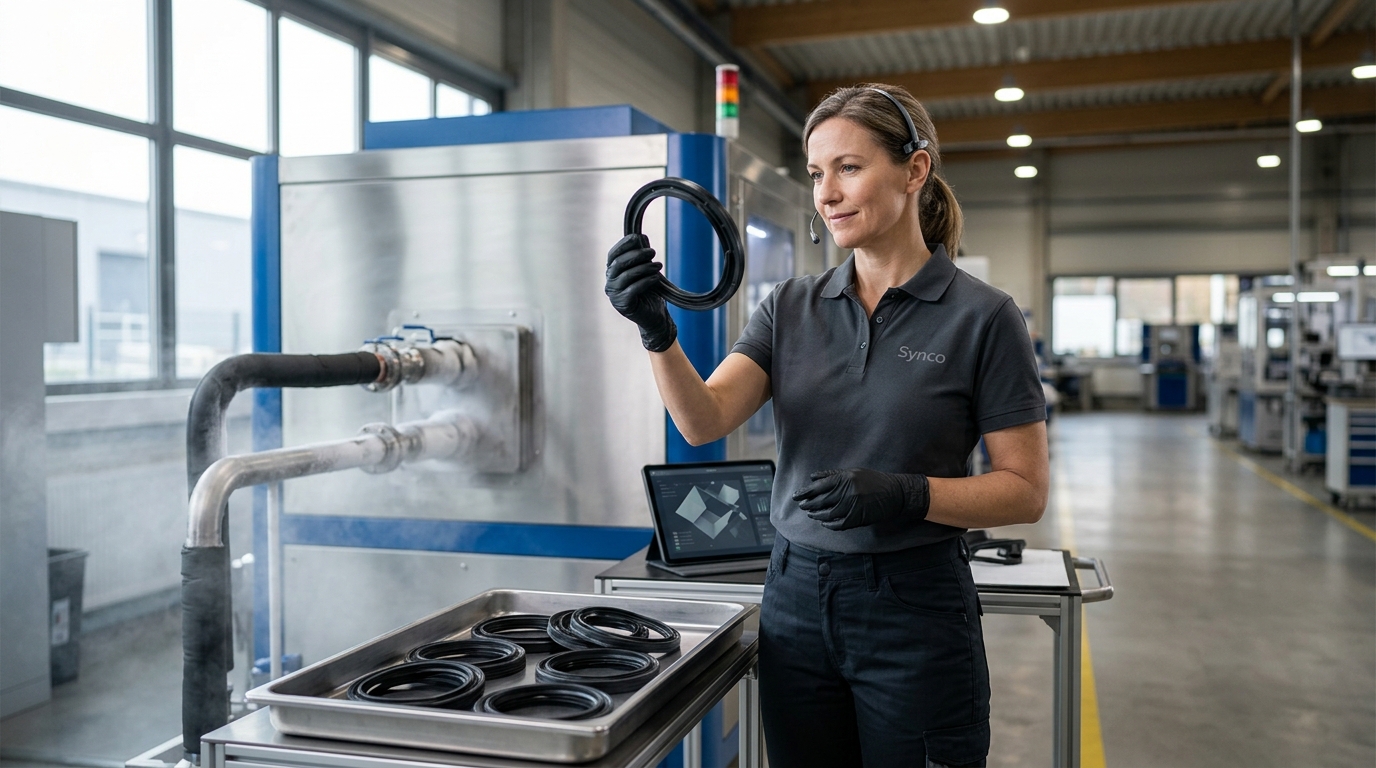
Cryogenic deflashing improves rubber component quality by using extreme cold to embrittle flash, allowing for precise, non-destructive removal. This process preserves the structural integrity of the rubber while eliminating excess material that compromises fit and finish. This guide covers the mechanics of flash brittleness, batch consistency, and dimensional accuracy in manufacturing. For additional details, review the Contact Us 8211 Synco.
Complex Geometry Removal
Traditional mechanical deflashing often struggles with intricate rubber parts. Sharp edges and deep cavities can be damaged by abrasive media or manual tools. Cryogenic deflashing excels in these scenarios because the flash becomes brittle and shatters upon impact. This allows for the removal of material from tight corners without stressing the main body of the component. Manufacturers of seals, gaskets, and molded elastomers benefit significantly from this capability. The process ensures that complex geometries retain their functional shape after cleaning. For additional details, review the About Us 8211 Synco.
The Cryogenic Deflashing Process
Temperature Control
Precise temperature control is critical for consistent results. The machine must maintain the liquid nitrogen bath at a stable temperature. Fluctuations can lead to incomplete embrittlement or damage to the part. Modern systems use automated sensors and feedback loops to regulate the bath temperature. This ensures that every part in the batch receives the same thermal treatment.
Exposure Time
The duration of exposure to the cold environment determines the depth of embrittlement. Thicker flash requires longer exposure times to ensure the core of the material becomes brittle. Operators must calibrate the cycle time based on the specific elastomer and part thickness. Too short a time leaves flash intact, while too long a time can affect the base material. For additional details, review the Projects 8211 Synco Industries.
Flash Brittleness Mechanism
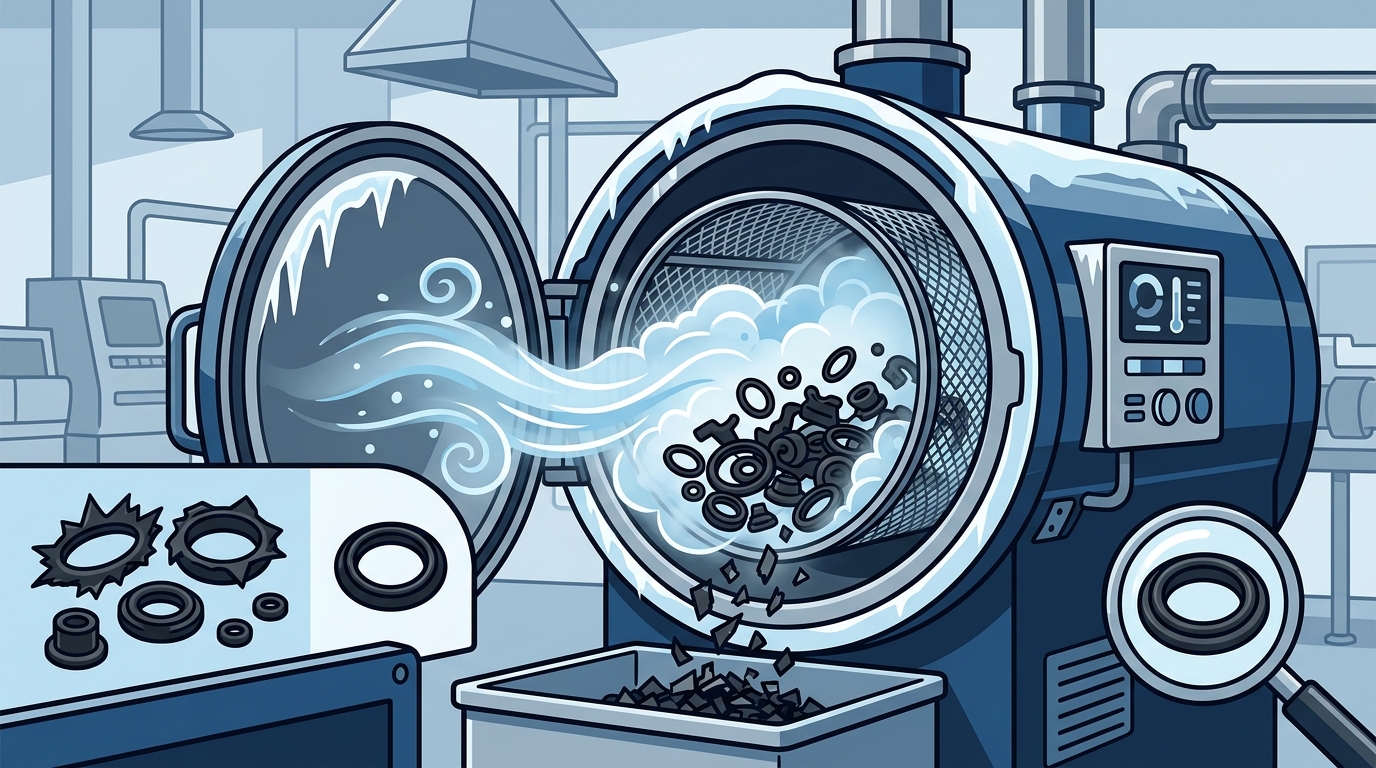
Flash brittleness is the physical phenomenon where elastomeric material loses its elasticity at cryogenic temperatures. Rubber is a viscoelastic material that is flexible at room temperature. When cooled rapidly, the polymer chains lose their ability to move and rotate. The material transitions from a rubbery state to a glassy state. In this glassy state, the flash is hard and brittle, similar to glass. This makes it susceptible to fracture under mechanical stress. For additional details, review the Ovens 8211 Synco Industries.
Viscoelastic Transition
The transition temperature for most rubbers is well above the temperature of liquid nitrogen. This large temperature differential ensures a complete phase change. The flash material becomes rigid and loses its ability to absorb energy through deformation. Instead, it stores energy until the stress exceeds its fracture strength. This results in a clean break rather than a tear.
Fracture Propagation
Once the flash is brittle, cracks propagate rapidly through the material. The fracture surface is typically clean and flat. This is in contrast to mechanical grinding, which can leave a rough or uneven surface. The clean fracture surface is ideal for subsequent coating or assembly processes. It ensures that no residual stress remains in the part.
Batch Consistency and Automation
Batch consistency is a major advantage of automated cryogenic deflashing. Manual deflashing is highly dependent on operator skill and fatigue. This leads to variations in finish and potential damage to parts. Automated machines provide a repeatable process for every part in a batch. The parts are loaded into a basket and submerged in the liquid nitrogen. After the cooling phase, the parts are moved to a deflashing chamber. Here, they are subjected to a controlled impact or vibration. The result is a uniform finish across the entire production run.
Reduced Human Error
Automation eliminates the variability introduced by human operators. The machine follows a predefined cycle that is identical for every batch. This reduces the need for extensive quality inspection. It also allows for unattended operation, increasing overall equipment effectiveness. Manufacturers can run the machine during off-hours to maximize throughput.
Process Documentation
Flash Removal Mechanism
The flash removal mechanism in cryogenic deflashing relies on impact and vibration. After the parts are cooled, they are placed in a tumbling or vibrating chamber. The parts collide with each other or with a media bed. The brittle flash shatters and detaches from the part. The fragments are then separated from the parts using sieves or air jets. This separation step is crucial for preventing contamination. The removed flash fragments are collected and can be recycled or disposed of.
Impact Energy
The energy of the impact must be sufficient to fracture the flash. However, it must not be so high that it damages the base material. The machine controls the impact energy through the speed of the tumbling or vibration. This allows for fine-tuning of the process for different part sizes and materials. A gentle impact is sufficient for thin flash, while a more energetic impact is needed for thicker material.
Media Selection
Some systems use a media bed to cushion the parts and provide a consistent impact surface. The media can be made of plastic, rubber, or metal. The choice of media depends on the part material and the desired finish. A soft media bed is suitable for delicate parts, while a harder media bed is used for robust components. The media is also used to separate the flash fragments from the parts.
Liquid Nitrogen Embrittlement
Liquid nitrogen embrittlement is the specific use of liquid nitrogen to achieve the glassy state in rubber. Liquid nitrogen has a boiling point of -196 degrees Celsius. This temperature is far below the glass transition temperature of most elastomers. The rapid cooling rate of liquid nitrogen ensures that the flash is cooled uniformly. This prevents thermal gradients that could cause internal stresses. The use of liquid nitrogen is preferred over other cryogenic fluids due to its safety and availability.
Safety Considerations
Environmental Impact
Liquid nitrogen is an environmentally friendly cryogenic fluid. It is a component of the atmosphere and does not contribute to ozone depletion or global warming. The use of liquid nitrogen in cryogenic deflashing is a sustainable alternative to chemical deflashing. It eliminates the need for hazardous solvents and waste disposal. This makes it a preferred choice for manufacturers committed to environmental responsibility.
Dimensional Accuracy and Tolerances
Cryogenic deflashing preserves the dimensional accuracy of rubber components. The process removes only the excess flash material without altering the part geometry. This is critical for parts that must fit into tight tolerances. Mechanical grinding can remove material from the part body, leading to dimensional drift. Cryogenic deflashing avoids this issue by targeting only the brittle flash. The result is a part that meets the original design specifications. This is essential for applications in automotive, aerospace, and medical industries.
Tolerance Preservation
The process maintains the dimensional stability of the part. The base material remains flexible and does not undergo significant dimensional change. This ensures that the part fits correctly in its assembly. It also prevents the need for rework or rejection of parts. This reduces scrap rates and improves overall yield. Manufacturers can achieve higher first-pass yields with cryogenic deflashing.
Surface Finish
The surface finish of the part is also preserved by cryogenic deflashing. The process does not leave scratches or marks on the part surface. This is important for aesthetic and functional reasons. A smooth surface finish is required for many applications, such as seals and gaskets. Cryogenic deflashing provides a clean and uniform surface finish. This enhances the performance and longevity of the part.
Key Takeaways
- The process is ideal for complex geometries that are difficult to clean mechanically.
- Flash brittleness is achieved by cooling the material below its glass transition temperature.
- Automated systems ensure batch consistency and reduce human error.
- The flash removal mechanism relies on controlled impact and vibration.
- Liquid nitrogen is a safe and environmentally friendly cryogenic fluid.
- The process preserves dimensional accuracy and surface finish.
- Cryogenic deflashing reduces scrap rates and improves overall yield.
Frequently Asked Questions
What is cryogenic deflashing?
How does liquid nitrogen embrittle rubber?
Liquid nitrogen cools the rubber below its glass transition temperature, causing it to become brittle and shatter upon impact.
Is cryogenic deflashing suitable for all rubber types?
Most elastomers can be processed, but the specific temperature and time must be calibrated for each material.
Does the process damage the part?
No, the process targets only the brittle flash, leaving the flexible base material intact.
How long does the process take?
The cycle time depends on the part size and flash thickness, typically ranging from a few minutes to an hour.
Is liquid nitrogen safe to use?
Yes, it is non-toxic and non-flammable, but proper ventilation and personal protective equipment are required.
Can the process be automated?
Yes, automated machines are available that handle the cooling, deflashing, and separation steps.Does cryogenic deflashing affect the part's dimensions?
No, the process preserves the dimensional accuracy of the part by removing only the excess flash.