

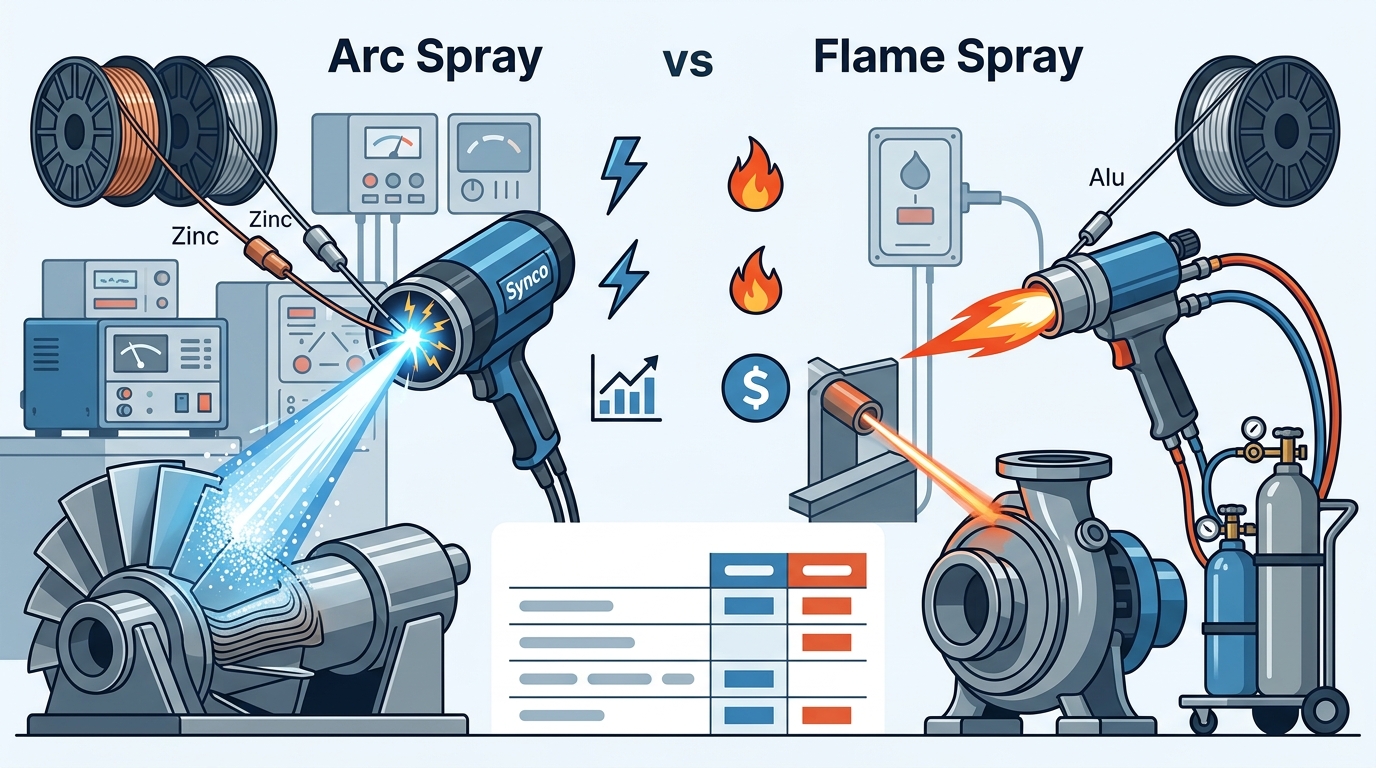
Arc spray systems use an electric arc to melt wire feedstock, while flame spray systems use a fuel gas and oxygen flame. Arc spray generally offers higher deposition rates and stronger metallurgical bonds, whereas flame spray provides better portability and lower initial equipment costs. This guide explores the technical differences, operational costs, and practical applications of both methods to help manufacturers select the right thermal coating solution for their specific production needs.
Deposition Rates and Efficiency
Deposition rate is a critical metric in thermal spraying, defined as the mass of coating material applied to a substrate per unit of time. It directly impacts production throughput and cycle time. Understanding this metric helps engineers balance speed against coating quality and material consumption. For additional details, review the About Us Synco Industries.
How Arc Spray Achieves High Speed
Arc spray systems utilize an electric arc between the wire and the nozzle to melt the material. This process generates extremely high temperatures, often exceeding 3,000 degrees Celsius, which allows for rapid melting and atomization. The high energy input results in a high velocity of particles impacting the substrate. Consequently, arc spray systems typically achieve deposition rates that are significantly higher than those of flame spray systems. This efficiency makes arc spray ideal for high-volume production environments where time is a critical factor. For additional details, review the Products Synco Industries.
Flame Spray Deposition Characteristics
Flame spray systems rely on the combustion of a fuel gas, such as acetylene or propane, mixed with oxygen. The resulting flame temperature is lower than that of an electric arc, typically ranging between 2,500 and 3,000 degrees Celsius depending on the fuel. While still capable of melting most common metals, the lower energy density results in a slower melting process. As a result, the deposition rate for flame spray is generally lower. However, for certain applications where a slower, more controlled application is preferred, this characteristic can be advantageous. For additional details, review the axiom Synco Industries.
Bond Strength and Coating Integrity
Bond strength is the measure of the adhesion between the thermal spray coating and the base substrate. It is a primary determinant of the coating's durability and resistance to peeling or spalling under mechanical stress. Manufacturers must evaluate bond strength to ensure the coating meets the required service life specifications.
Mechanisms of Adhesion in Arc Spray
In arc spray, the molten particles are accelerated to very high velocities before impacting the substrate. This high kinetic energy causes the particles to flatten and deform upon impact, creating a strong mechanical interlock with the surface. Additionally, the high temperature of the particles promotes some degree of metallurgical bonding. The combination of mechanical interlocking and thermal bonding results in superior bond strength. This makes arc spray coatings highly resistant to delamination, even in demanding industrial applications.
Adhesion Properties of Flame Spray
Flame spray particles generally travel at lower velocities compared to arc spray particles. While they still achieve sufficient kinetic energy to bond to the substrate, the impact force is lower. This can result in a coating with slightly lower bond strength compared to arc spray. However, flame spray coatings are still widely used in applications where moderate bond strength is sufficient. The choice between the two often depends on the specific mechanical requirements of the component being coated.
Operating Costs and Economic Analysis
Operating costs encompass all expenses associated with running a thermal spray system, including energy consumption, consumables, and maintenance. A thorough analysis of these costs is essential for determining the total cost of ownership and return on investment for thermal coating operations.
Energy Consumption and Utility Costs
Arc spray systems require a significant amount of electrical power to generate the arc. This high energy consumption can lead to higher utility costs, particularly in regions with expensive electricity rates. In contrast, flame spray systems consume fuel gas and oxygen. The cost of these gases varies by region and supplier, but they are often less expensive per unit of energy than electricity. Therefore, flame spray systems may have lower direct energy costs in some operational contexts.
Consumables and Maintenance Expenses
Both systems require consumables such as nozzles, tips, and filters. Arc spray nozzles and tips wear out faster due to the high temperatures and electrical currents involved. This leads to more frequent replacement and higher consumable costs. Flame spray nozzles, while also subject to wear, typically last longer. Maintenance schedules for both systems are critical to ensure consistent performance and prevent downtime. Manufacturers should factor in these ongoing expenses when comparing the two technologies.
Equipment Portability and Setup
Equipment portability refers to the ease with which a thermal spray system can be moved and set up in different locations. This factor is crucial for field repairs, on-site maintenance, and mobile manufacturing operations. The physical size, weight, and power requirements of the equipment all influence its portability.
Portability of Arc Spray Systems
Arc spray systems typically require a robust power supply, which can be a heavy and bulky component. This makes them less portable than flame spray systems. Setting up an arc spray system in a field environment may require a generator or access to a high-capacity electrical outlet. The complexity of the power setup can limit the flexibility of arc spray operations in remote or mobile settings.
Portability of Flame Spray Systems
Flame spray systems are generally more portable due to their reliance on gas cylinders rather than heavy electrical power supplies. The equipment is often lighter and easier to transport. This makes flame spray systems well-suited for field applications, such as repairing large structures, pipelines, or machinery in remote locations. The ease of setup and teardown is a significant advantage for mobile maintenance teams.
Technical Comparison Table
The following table summarizes the key technical differences between arc spray and flame spray systems. This reference aids in quick decision-making for engineering and procurement teams.
| Feature | Arc Spray System | Flame Spray System |
|---|---|---|
| Energy Source | Electric Arc | Fuel Gas and Oxygen |
| Deposition Rate | High | Moderate to Low |
| Bond Strength | High | Moderate |
| Portability | Lower (Requires Power Supply) | Higher (Gas Cylinders) |
| Initial Equipment Cost | Higher | Lower |
| Typical Applications | High-Volume Production, Wear Parts | Field Repairs, Mobile Maintenance |
Key Takeaways
- Flame spray provides better portability and lower initial equipment costs, suitable for field repairs.
- Deposition rate is defined as the mass of coating applied per unit of time, directly impacting throughput.
- Bond strength is the measure of adhesion between the coating and substrate, critical for durability.
- Operating costs include energy, consumables, and maintenance, which vary significantly between the two systems.
- Equipment portability depends on power requirements, with flame spray systems being easier to transport.
- Manufacturers should select the system based on specific application requirements, such as production volume and location.
- Both systems require proper maintenance and operator training to ensure consistent coating quality.
Frequently Asked Questions
What is the main difference between arc spray and flame spray?
The main difference is the energy source. Arc spray uses an electric arc to melt wire, while flame spray uses a fuel gas and oxygen flame. This results in different deposition rates, bond strengths, and portability characteristics.
Which system has a higher deposition rate?
Arc spray systems generally have a higher deposition rate due to the higher energy input from the electric arc. This allows for faster melting and application of the coating material.
Is flame spray more portable than arc spray?
Yes, flame spray systems are typically more portable. They rely on gas cylinders rather than heavy electrical power supplies, making them easier to transport and set up in field environments.
What is the bond strength of arc spray coatings?
Arc spray coatings generally exhibit high bond strength due to the high velocity and temperature of the particles. This results in strong mechanical and metallurgical bonding with the substrate.
How do operating costs compare between the two systems?
Arc spray systems may have higher energy costs due to electricity consumption, while flame spray systems have lower energy costs but potentially higher consumable costs. The total cost of ownership depends on specific operational factors.
Can flame spray be used for high-volume production?
While flame spray can be used for production, its lower deposition rate makes it less efficient for high-volume applications compared to arc spray. It is often preferred for lower-volume or field applications.
What types of materials can be sprayed with both systems?
Both systems can spray a wide range of metals, including steel, aluminum, and nickel alloys. The specific material compatibility depends on the melting point and thermal properties of the wire feedstock.
How does Synco Industries support thermal spray operations?
Synco Industries provides a complete range of thermal spray equipment, including arc and flame spray systems, along with consumables and spares. They offer solutions designed for consistent results and long operational life.