

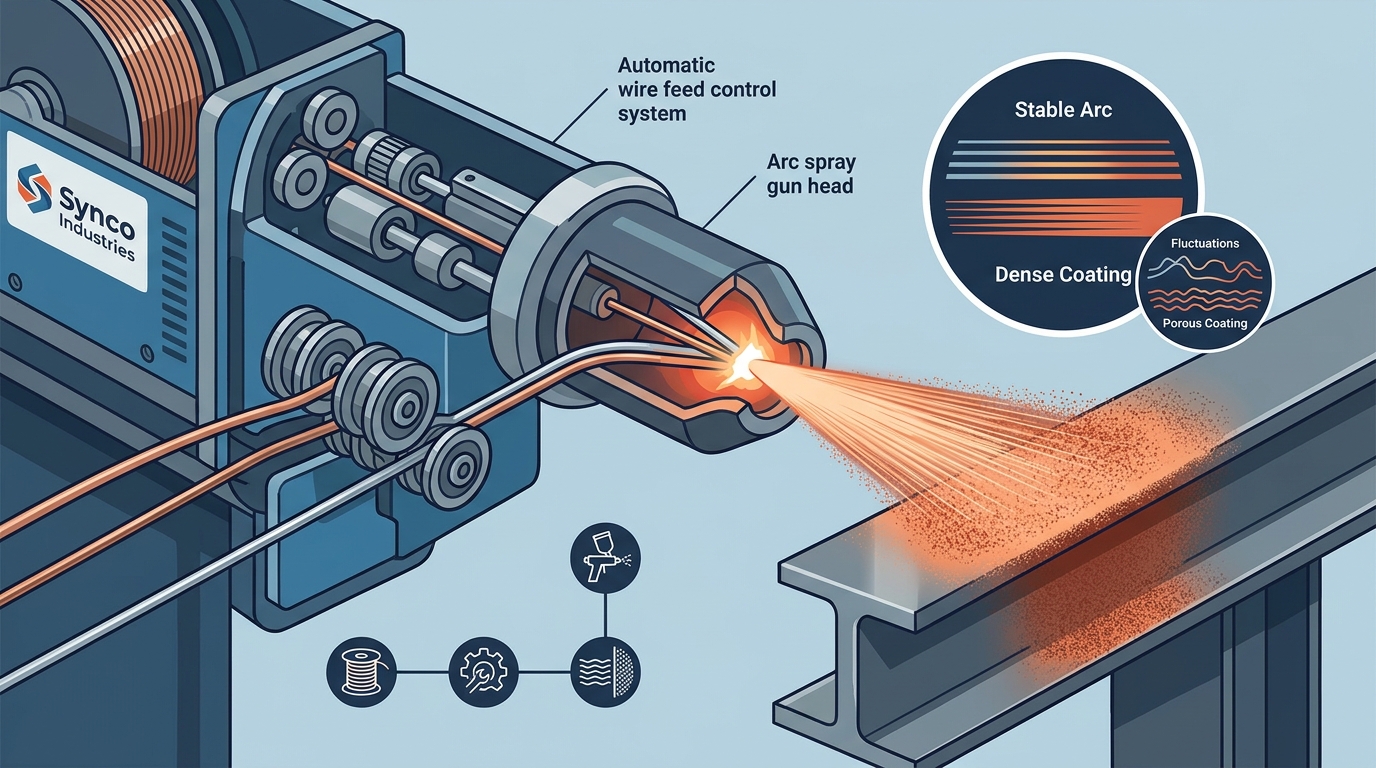
Wire feed control is the primary mechanical variable that dictates the stability of the electric arc and the uniformity of the molten metal stream in arc spray applications. Inconsistent feed rates cause fluctuations in arc length and particle velocity, leading to porous or uneven coatings. Synco Industries emphasizes that precise wire feed regulation is essential for achieving the dense, well-bonded metallic coatings required in heavy engineering and corrosion protection sectors.
The Physics of Arc Stability
Arc spray is a thermal spray process that uses an electric arc to melt wire feedstock and propel it onto a substrate. The stability of this arc is directly dependent on the rate at which the wire is fed into the gun. When the feed rate is constant, the arc length remains stable, ensuring that the energy input to the wire is consistent. If the feed rate fluctuates, the arc length changes, which alters the temperature and velocity of the sprayed particles. For additional details, review the Synco Industries.
This variation in particle velocity impacts the kinetic energy at impact. Particles that are too slow may not deform sufficiently to bond with the substrate, while particles that are too fast may cause spatter or rebound. Synco Industries designs its systems to maintain a steady arc, recognizing that arc stability is the foundation of coating quality. A stable arc ensures that the molten droplets are of a uniform size, which is critical for a dense coating structure.
Impact on Coating Density and Porosity
Coating density is a key metric for the performance of thermal spray coatings. Wire feed control directly influences the packing density of the coating. When the wire feed is consistent, the molten particles arrive at the substrate in a steady stream, allowing them to overlap and interlock effectively. This results in a dense coating with minimal porosity. Conversely, inconsistent feed rates lead to gaps between particles, increasing porosity and reducing the coating's protective capabilities.
High porosity can allow corrosive agents to penetrate the coating and reach the base metal, leading to premature failure. Synco Industries focuses on minimizing porosity through precise feed control. By ensuring a continuous and uniform supply of molten metal, the system promotes a tight, cohesive coating. This is particularly important for applications involving zinc and aluminum coatings, where corrosion resistance is the primary goal.
Adhesion and Bond Strength
Adhesion is the measure of how well the coating bonds to the substrate. Wire feed control affects adhesion by influencing the temperature and velocity of the particles. A consistent feed rate ensures that the particles reach the substrate at the optimal temperature and speed. This allows the particles to deform and form strong mechanical and metallurgical bonds with the base metal. If the feed rate is too low, the particles may be underheated and fail to bond properly. If the feed rate is too high, the particles may be overheated and lose their structural integrity.
Surface Finish and Aesthetics
Surface finish is another aspect of coating quality that is influenced by wire feed control. A consistent feed rate produces a smooth and uniform surface. Fluctuations in feed rate can lead to a rough or uneven surface, which may be unacceptable for aesthetic or functional reasons. For example, in the coating of visible structural steel, a smooth finish is often required. Synco Industries recognizes the importance of surface finish and designs its systems to produce a consistent spray pattern.
The spray pattern is determined by the interaction between the wire feed rate and the gas flow. A stable feed rate ensures that the spray pattern remains consistent throughout the application. This results in a uniform coating thickness and a smooth surface. Synco Industries provides guidance on optimizing feed rates for different wire types and substrates to achieve the desired surface finish. This level of control is essential for high-quality industrial coatings.
Operational Efficiency and Material Usage
Wire feed control also impacts operational efficiency and material usage. A consistent feed rate ensures that the wire is used efficiently, minimizing waste. Inconsistent feed rates can lead to spatter and overspray, which increases material consumption and cleanup time. Synco Industries designs its systems to maximize material efficiency, reducing the cost of coating production. Efficient material usage is important for large-scale applications, such as the coating of structural steel or large components.
By maintaining a stable feed rate, operators can achieve higher deposition rates and shorter coating times. This improves productivity and reduces the overall cost of the coating process. Synco Industries provides training and support to help operators optimize their feed rates for maximum efficiency. This focus on operational efficiency makes arc spray a cost-effective solution for industrial coating applications.
Key Takeaways
- Wire feed control is the primary variable affecting arc stability in arc spray applications.
- Consistent feed rates lead to uniform particle velocity and size, which improves coating density.
- Stable wire feed reduces porosity, enhancing the corrosion resistance of the coating.
- Optimal feed control ensures strong adhesion by providing particles at the correct temperature and speed.
- Uniform feed rates produce a smooth surface finish and consistent spray pattern.
- Precise feed control improves material efficiency and reduces waste in large-scale applications.
- Synco Industries integrates precise feed control into its systems to ensure high-quality coatings.
Frequently Asked Questions
How does wire feed rate affect arc length?
The wire feed rate directly determines the arc length. A higher feed rate shortens the arc, while a lower feed rate lengthens it. Maintaining a constant feed rate is essential for keeping the arc length stable.
What happens if the wire feed is inconsistent?
Inconsistent wire feed leads to fluctuations in arc energy and particle velocity. This results in a porous, uneven coating with poor adhesion and reduced protective performance.
Why is coating density important in arc spray?
Coating density is critical for the protective performance of the coating. A dense coating with low porosity prevents the penetration of corrosive agents, extending the life of the substrate.
How does Synco Industries ensure consistent wire feed?
Synco Industries uses precision-engineered feed mechanisms and high-quality wire feedstock to ensure consistent wire delivery. The company also provides training to help operators optimize feed rates.
Can wire feed control improve adhesion?
Yes, by ensuring that particles reach the substrate at the optimal temperature and velocity, consistent wire feed control promotes strong mechanical and metallurgical bonds.
What is the impact of wire feed on surface finish?
Consistent wire feed produces a smooth and uniform surface finish. Fluctuations in feed rate can lead to a rough or uneven surface, which may be unacceptable for certain applications.
Conclusion
Wire feed control is a critical factor in determining the quality of arc spray coatings. By maintaining a consistent feed rate, operators can ensure arc stability, high coating density, strong adhesion, and a smooth surface finish. Synco Industries is committed to providing high-performance arc spray systems that deliver precise wire feed control. To explore how Synco Industries can support your coating needs, for a consultation.