
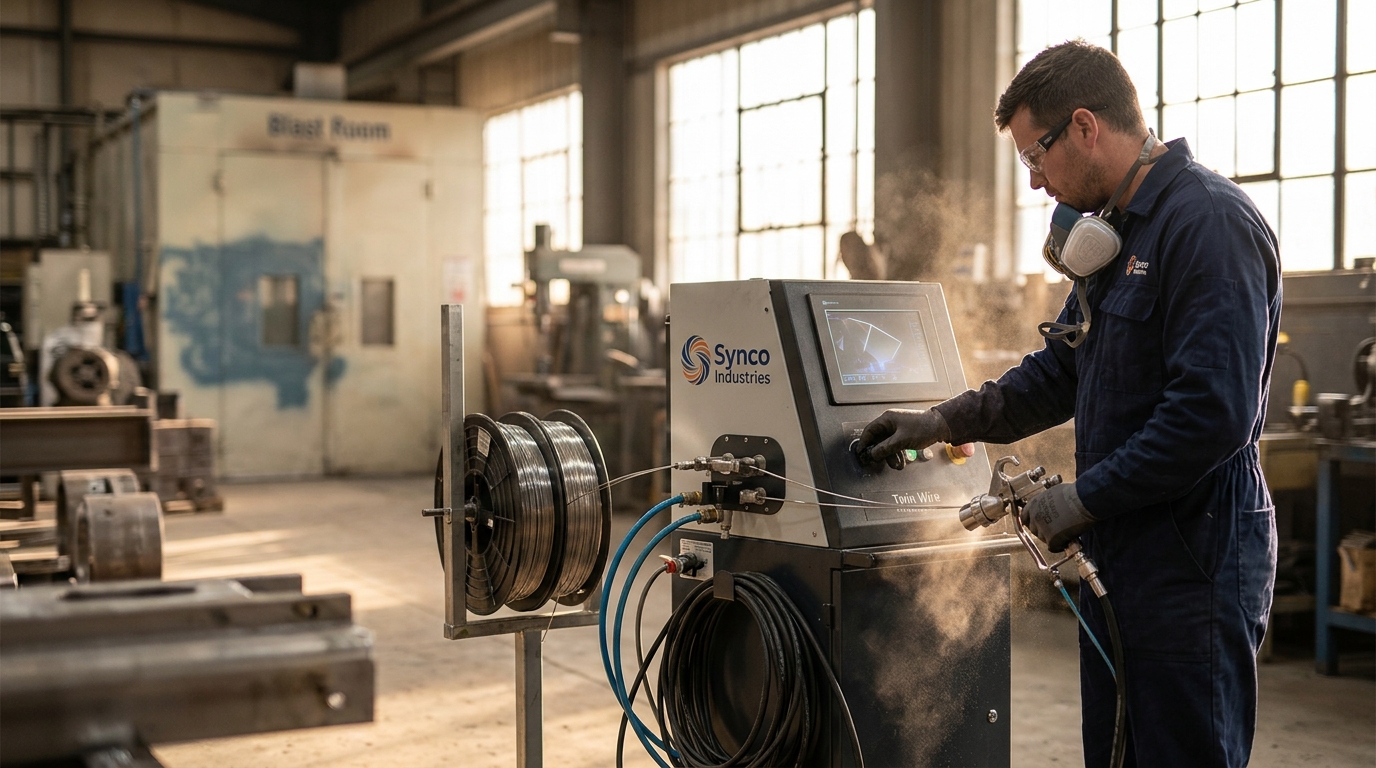
Arc spray system is a thermal spray process that uses an electric arc to melt twin wire consumables and atomize them with compressed air. In Jodhpur, Rajasthan, consistent coating quality depends on precise control of wire feed, arc voltage, and atomizing air. This guide details the critical features of industrial arc spray systems that ensure uniform, adherent, and corrosion-resistant coatings for heavy-duty applications.
Wire Feed Control
Wire feed control is the mechanism that delivers twin consumable wires to the arc zone at a constant rate. Inconsistent wire feed leads to variations in droplet size and coating density. Synco Industries designs arc spray systems with robust, heavy-duty wire feeders to maintain stability during 24/7 industrial duty.
Capstan Drive Mechanisms
Capstan drive feeders use rotating rollers to grip the wire. This method provides high torque and precise speed control. It is essential for maintaining a stable arc when spraying thick coatings for dimensional build-up.
Wire Tension Management
Proper tension prevents wire buckling and ensures smooth entry into the arc. Automated tensioners adjust for wire spool diameter changes, preventing feed interruptions that compromise coating quality.
Arc Voltage Stability
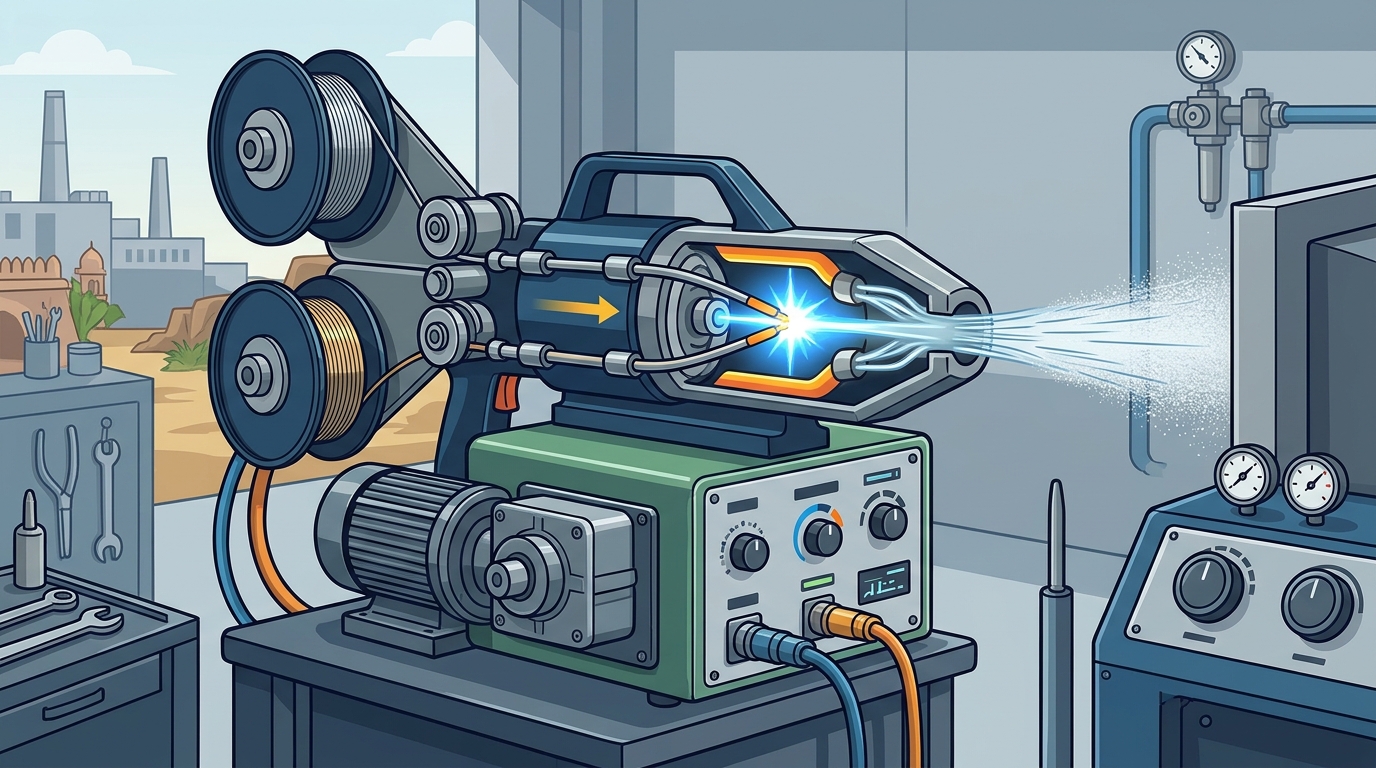
Arc voltage stability refers to the consistency of the electrical potential difference between the twin wires. Stable voltage ensures uniform melting of the wire tips. Fluctuations in voltage cause irregular droplet formation, leading to porous or uneven coatings.
Power Source Design
High-quality power sources with low inductance respond quickly to changes in arc length. This rapid response maintains a stable arc even when the spray gun moves. Synco Industries utilizes industrial-grade power sources to ensure consistent coating adhesion.
Current Regulation
Constant current regulation prevents arc extinction. It ensures that the heat input remains constant, which is critical for achieving the desired metallurgical properties in the coating.
Atomizing Air Management
Atomizing air management is the process of delivering compressed air to break the molten wire into fine droplets. The air pressure and flow rate directly influence the spray pattern and coating thickness. Proper management ensures a narrow, focused spray cone for high deposition rates.
Pressure Regulation
Regulators maintain consistent air pressure despite fluctuations in the plant air supply. This consistency is vital for achieving uniform droplet size distribution.
Air Filtration
Moisture and oil in the air supply can cause porosity and poor adhesion. Integrated filtration systems remove contaminants, ensuring a clean atomizing environment.
Nozzle Geometry
Nozzle geometry is the physical design of the spray gun tip that shapes the atomizing air flow. The geometry determines the spray cone angle and the velocity of the droplets. A well-designed nozzle ensures that droplets strike the substrate at the optimal angle for maximum adhesion.
Cone Angle Optimization
Narrow cone angles provide high velocity and thin coatings. Wider angles cover larger areas but may reduce droplet velocity. Selecting the correct geometry is key to balancing coverage and quality.
Wear Resistance
Nozzles are subject to high-temperature erosion. Using wear-resistant materials extends service life and maintains spray pattern consistency over time.
Closed Loop Monitoring
Closed loop monitoring is a feedback system that continuously measures process parameters and adjusts them in real-time. It ensures that the arc spray process stays within specified limits. This technology is critical for high-volume production where consistency is non-negotiable.
Parameter Tracking
Sensors track wire feed speed, arc voltage, and air pressure. Data is logged for traceability and quality assurance. This allows operators to identify trends and prevent defects before they occur.
Automated Adjustments
The system automatically adjusts parameters to compensate for environmental changes or consumable wear. This maintains coating quality without constant operator intervention.
Spray Automation
Spray automation involves the use of robotic or CNC-controlled gun movement. It ensures that the spray gun follows a precise path relative to the substrate. This repeatability is essential for achieving uniform coating thickness across complex geometries.
Robotic Integration
Path Programming
Advanced software allows operators to program spray paths. This ensures that every part receives the same coating profile, reducing rework and material waste.
Substrate Preparation
Substrate preparation is the process of cleaning and roughening the base metal surface before spraying. Proper preparation is the foundation of coating adhesion. Without it, even the best arc spray system will produce a coating that fails prematurely.
Surface Roughness
Shot blasting or grinding creates a rough surface profile. This increases the mechanical interlocking between the coating and the substrate. The roughness profile must be consistent across the entire part.
Contaminant Removal
Oil, grease, and rust must be completely removed. Contaminants act as barriers to adhesion. Solvent cleaning and degreasing are standard steps in the preparation process.
Comparison of Arc Spray System Features
| Feature | Impact on Coating Quality | Key Benefit |
|---|---|---|
| Wire Feed Control | Uniform droplet size | Consistent density and thickness |
| Arc Voltage Stability | Uniform melting | Stable metallurgical properties |
| Atomizing Air Management | Fine droplet distribution | Smooth surface finish |
| Nozzle Geometry | Optimal impact angle | Maximum adhesion strength |
| Closed Loop Monitoring | Real-time correction | Reduced defect rate |
Key Takeaways
- Wire feed control ensures a constant supply of consumable material to the arc.
- Arc voltage stability is critical for uniform melting and droplet formation.
- Atomizing air management determines the spray pattern and droplet size.
- Nozzle geometry affects the velocity and angle of droplet impact.
- Closed loop monitoring provides real-time feedback for process consistency.
- Spray automation ensures repeatability and uniform coverage.
- Substrate preparation is the most critical factor for coating adhesion.
- Synco Industries provides robust arc spray systems designed for heavy industrial duty.
Frequently Asked Questions
What is the primary advantage of arc spray over other thermal spray methods?
Arc spray offers the highest deposition rate and lowest cost per kilogram of coating. It is ideal for large surface areas and continuous production environments.
How does wire feed speed affect coating thickness?
Higher wire feed speeds increase the amount of material deposited per unit time. This results in thicker coatings but may require adjustments to air pressure to maintain droplet size.
Why is air filtration important in arc spray systems?
Moisture and oil in the air supply cause porosity and poor adhesion. Filtration ensures a clean atomizing environment, leading to higher quality coatings.
Can arc spray systems be automated?
Yes, arc spray systems can be integrated with robotic arms and CNC controllers. This allows for precise, repeatable spraying of complex geometries.
What role does substrate roughness play in adhesion?
Substrate roughness provides mechanical interlocking for the coating. A consistent roughness profile is essential for achieving high adhesion strength.
How often should nozzles be inspected?
Nozzles should be inspected regularly for wear. Erosion of the nozzle tip can alter the spray pattern, affecting coating quality. Replacement is necessary when wear exceeds specifications.
Conclusion
Achieving consistent coating quality in Jodhpur, Rajasthan, requires a comprehensive approach to arc spray system design and operation. From precise wire feed control to rigorous substrate preparation, every element of the process must be optimized. Synco Industries offers robust, high-productivity arc spray systems engineered for corrosion protection, dimensional build-up, and wear resistance. To explore our range of thermal spray equipment and find the right solution for your industrial needs, .