
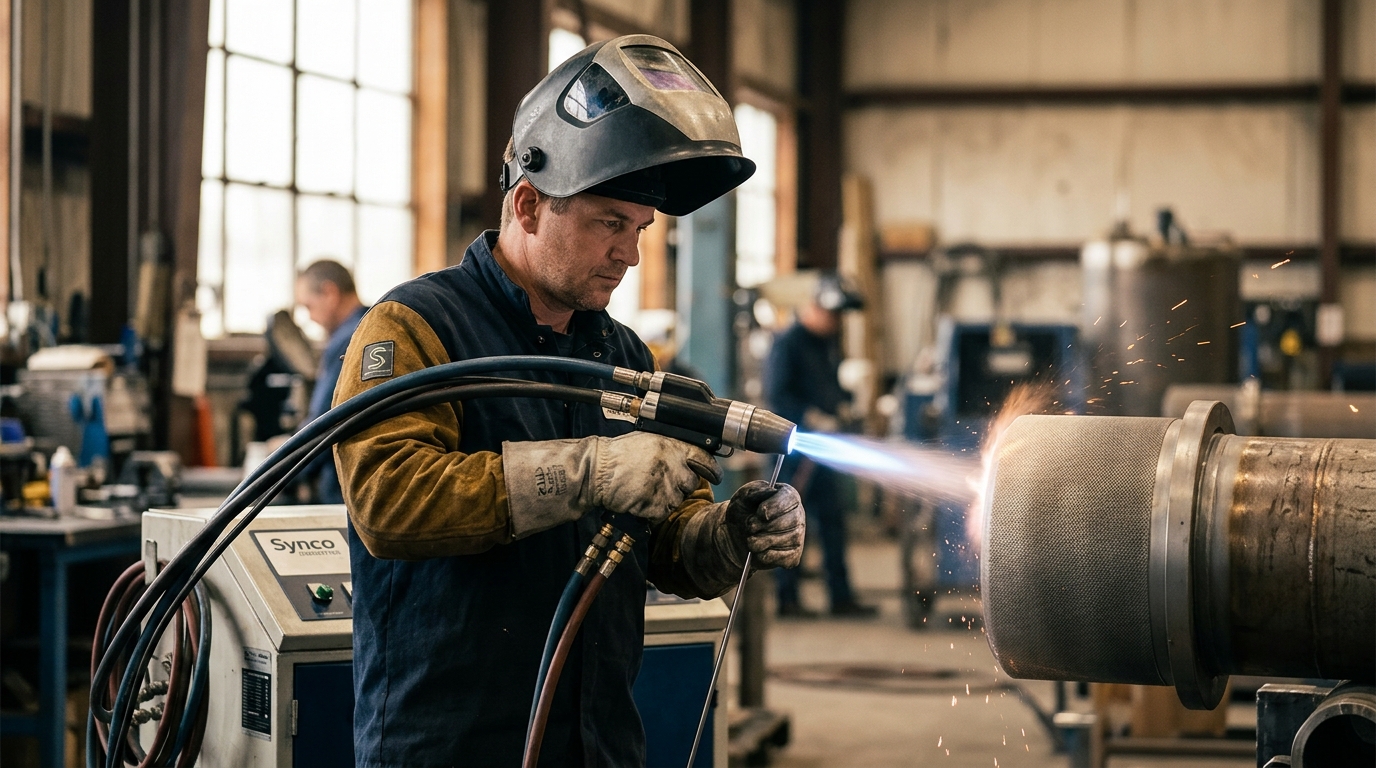
Choosing the right twin wire arc spray system is critical for manufacturers seeking to extend component life through durable thermal coatings. Consistent coating quality depends on precise control of arc parameters, material feed rates, and process automation. Synco Industries provides specialized thermal spray equipment designed to meet these rigorous industrial standards. This guide explores the technical factors that ensure reliable performance and long-term component protection.
Arc Voltage Control
Arc voltage is the primary electrical parameter governing the temperature and velocity of molten particles in a twin wire arc spray system. Stable voltage ensures that the wire feed melts consistently, preventing fluctuations in particle size and kinetic energy. Inconsistent voltage leads to porosity and poor adhesion, which are common failure modes in thermal coatings.
Impact on Particle Melting
The relationship between arc voltage and particle temperature is direct. Higher voltage increases the arc temperature, allowing for more complete melting of the wire material. Synco Industries designs its Arc Spray Systems with robust power supplies that maintain voltage stability even under varying load conditions. This stability is essential for achieving the desired coating microstructure.
Monitoring and Adjustment
Coating Uniformity
Coating uniformity refers to the consistency of thickness and density across the entire sprayed surface. A uniform coating ensures that stress is distributed evenly, preventing localized failure points. Achieving this requires precise control over the spray gun movement and the material deposition rate.
Gun Movement and Trajectory
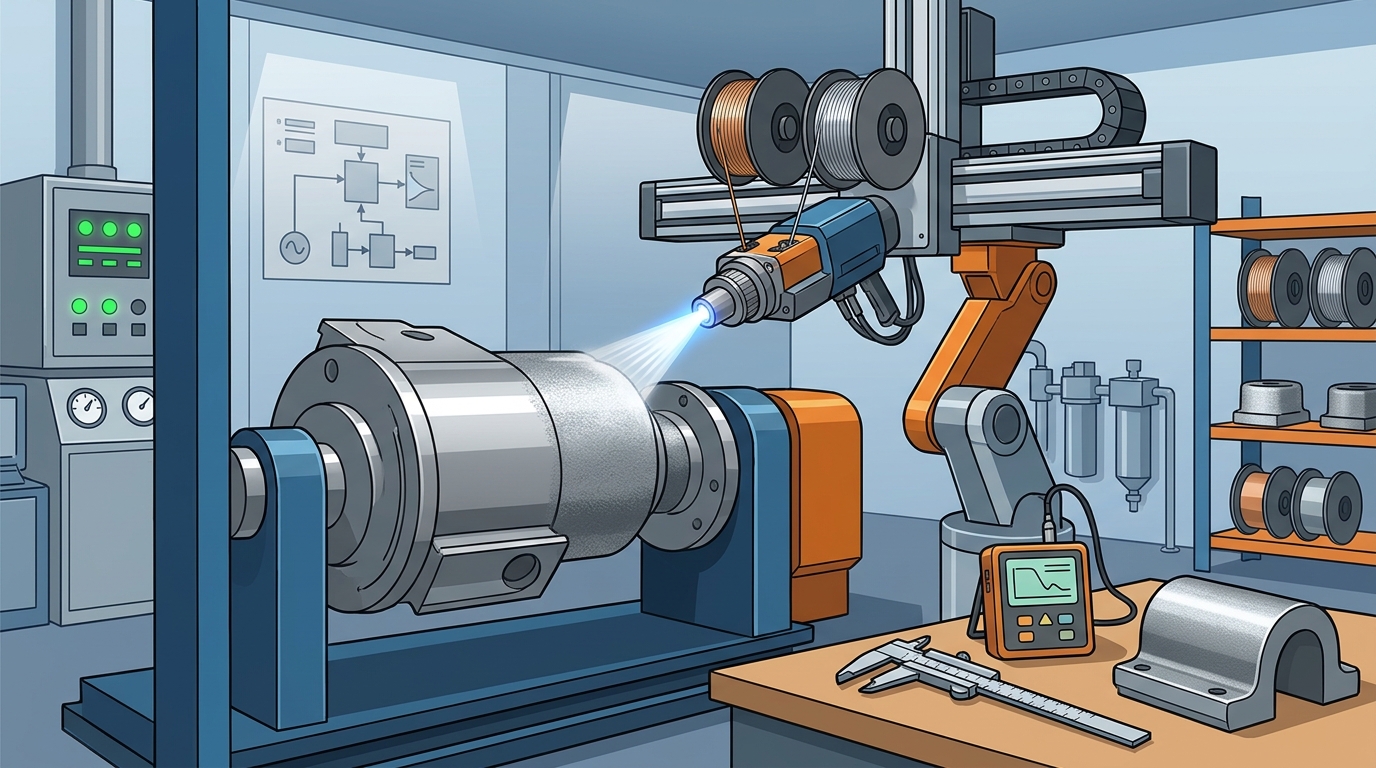
The trajectory of the spray gun relative to the workpiece significantly affects coating thickness. Automated systems use programmed paths to maintain a constant distance and angle. This consistency is crucial for large components where manual spraying might result in uneven coverage. Synco Industries offers Thermal Spray Equipments that integrate with robotic arms for precise gun positioning.
Material Distribution
Uniform material distribution depends on the stability of the wire feed. Twin wire systems feed two wires simultaneously, which can lead to uneven melting if the feed rates are not synchronized. Advanced controllers monitor the feed of both wires to ensure a balanced deposition. This synchronization is key to achieving a homogeneous coating with consistent mechanical properties.
Component Wear Protection
Thermal spray coatings are used to protect components from wear, corrosion, and erosion. The effectiveness of this protection depends on the bond strength and hardness of the coating. Twin wire arc spray systems are particularly effective for applying thick, ductile coatings that can withstand high impact loads.
Coating Hardness and Bond Strength
The hardness of the coating is determined by the cooling rate of the molten particles. Faster cooling results in a finer microstructure and higher hardness. Bond strength is influenced by the kinetic energy of the particles at impact. High-energy particles deform and bond strongly to the substrate, creating a durable interface. Synco Industries provides Thermal Spray Powders and wires that are optimized for high bond strength applications.
Application in Industrial Settings
Industries such as oil and gas, mining, and power generation rely on thermal spray coatings to extend the life of critical components. For example, pump shafts and valve stems are often coated to resist erosion from abrasive fluids. The ability to apply thick coatings in a single pass makes twin wire arc spray an efficient solution for these applications. Synco Industries has a track record of delivering reliable Projects that demonstrate the longevity of these coatings in harsh environments.
Automated Process Repeatability
Process repeatability is the ability to produce identical coatings on every part. This is essential for mass production and quality assurance. Automation reduces human error and ensures that each component receives the same treatment. Synco Industries emphasizes automation in its system design to guarantee consistent results.
Role of Automation
Automated systems use sensors and feedback loops to adjust process parameters in real-time. For instance, if the arc voltage drifts, the controller can adjust the wire feed rate to compensate. This closed-loop control ensures that the coating properties remain within specified limits. The integration of Spare Parts and maintenance services ensures that automated systems remain reliable over time.
Quality Assurance and Documentation
Repeatability also involves documentation. Automated systems can log process parameters for each part, creating a traceable record. This data is valuable for quality audits and for troubleshooting any issues that arise. By maintaining detailed logs, manufacturers can demonstrate compliance with industry standards and customer requirements. Synco Industries supports this by providing systems that generate comprehensive process reports.
Comparison of Key Parameters
| Parameter | Impact on Coating Quality | Control Method |
|---|---|---|
| Arc Voltage | Determines particle temperature and melting efficiency | Power supply regulation |
| Wire Feed Rate | Controls deposition rate and coating thickness | Motorized feed mechanisms |
| Gun Distance | Affects particle velocity and impact energy | Robotic positioning |
| Gas Flow Rate | Influences particle cooling and oxidation | Mass flow controllers |
Key Takeaways
- Arc voltage stability is the foundation of consistent particle melting and coating density.
- Coating uniformity requires precise control over gun movement and wire feed synchronization.
- High bond strength and hardness are critical for effective component wear protection.
- Automation reduces human error and ensures process repeatability in mass production.
- Real-time monitoring and feedback loops are essential for maintaining quality standards.
- Choosing a system with robust support and spare parts availability ensures long-term reliability.
- Synco Industries offers specialized equipment and expertise to meet these technical requirements.
Frequently Asked Questions
What is the primary advantage of twin wire arc spray over single wire?
Twin wire arc spray allows for higher deposition rates and the ability to blend two different materials. This flexibility is useful for creating coatings with specific mechanical or chemical properties.
How does arc voltage affect coating porosity?
Inconsistent arc voltage can lead to incomplete melting of the wire, resulting in porosity. Stable voltage ensures complete melting and a dense, non-porous coating.
Can twin wire arc spray be used for corrosion protection?
Yes, by selecting appropriate alloy wires, twin wire arc spray can produce coatings with excellent corrosion resistance. This is particularly useful in marine and chemical processing environments.
What role does automation play in coating quality?
Automation ensures that process parameters remain constant throughout the spraying process. This consistency is crucial for achieving uniform thickness and density across the entire component.
How important is wire feed synchronization?
Wire feed synchronization is critical for maintaining a stable arc and consistent deposition. Uneven feed rates can lead to fluctuations in coating thickness and properties.
What are the maintenance requirements for these systems?
Regular maintenance of the power supply, wire feed mechanisms, and gas delivery systems is essential. Synco Industries provides support for maintenance and spare parts to ensure system reliability.