
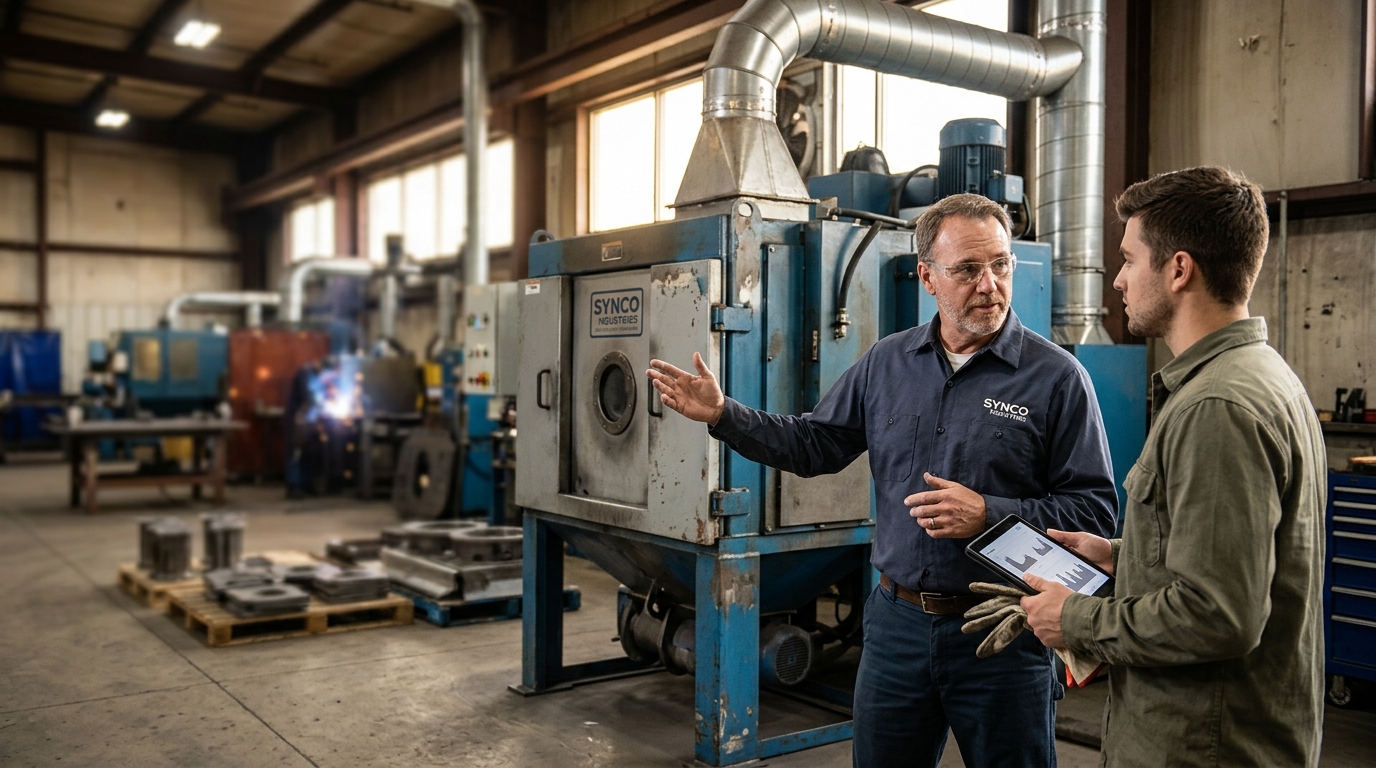
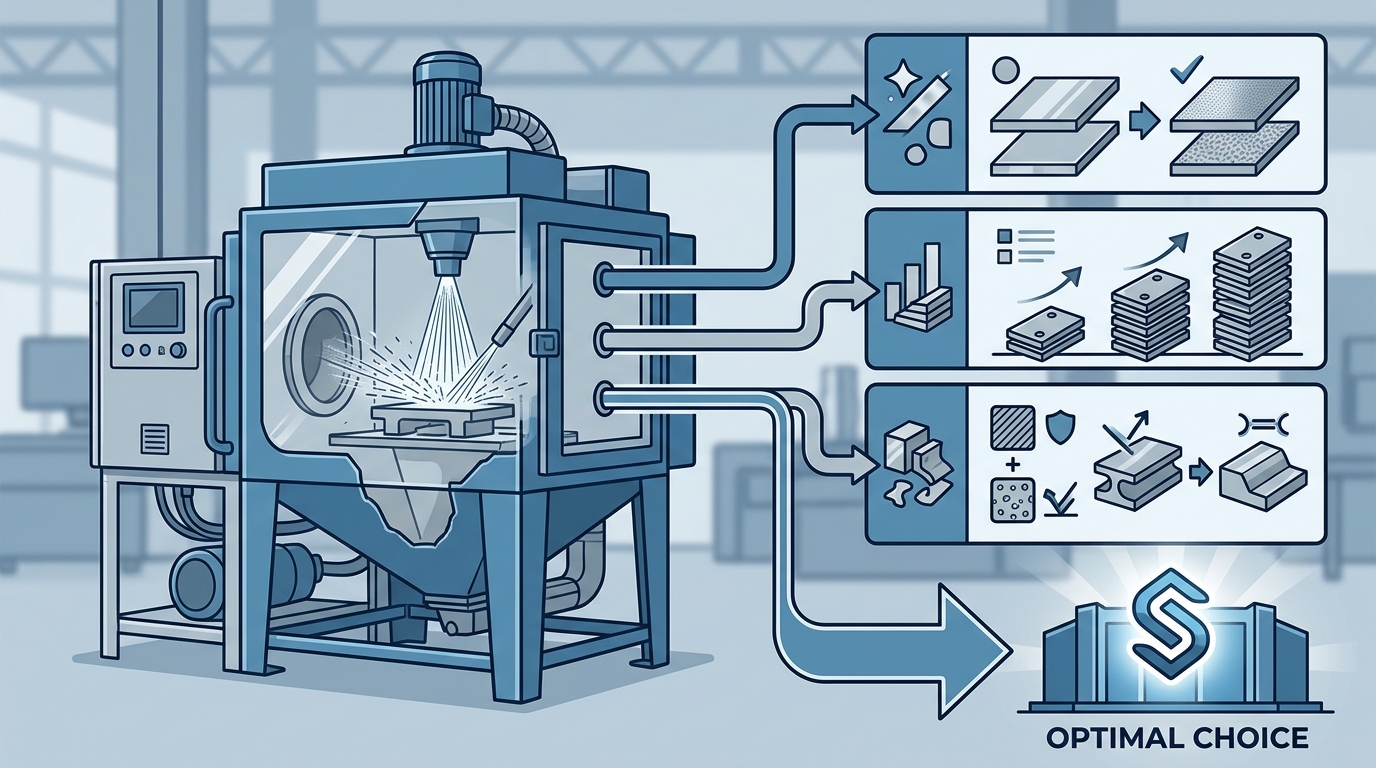
Before investing in a shot blasting machine, you must evaluate your specific surface preparation goals, production volume, and material compatibility. The right machine type, such as airless or air-assisted, directly impacts your operational efficiency and long-term return on investment. Synco Industries provides specialized guidance to help manufacturers select the optimal equipment for their unique industrial requirements.
Understanding Machine Types and Mechanisms
Shot blasting is a surface treatment process that uses high-velocity abrasive media to clean, strengthen, or profile metal surfaces. The primary distinction in equipment lies between air-assisted and airless systems. Air-assisted machines use compressed air to propel the abrasive, which is suitable for lighter cleaning tasks and smaller parts. In contrast, airless machines rely on centrifugal force from a wheel to accelerate the media, providing higher kinetic energy for heavy-duty applications.
For high-volume production, tumblast machines are often the preferred choice. These machines rotate a basket of parts, ensuring uniform coverage on all sides of the component. Synco Industries offers a range of tumblast machines, including models with dimensions such as 16x22 and 36x42, to accommodate various part sizes. Understanding the kinetic energy transfer in these systems is critical for achieving the desired surface finish without damaging the base material.
Selecting the Right Abrasive Media
The abrasive media is the consumable that performs the actual surface preparation. The choice of media depends on the material being treated and the desired outcome. Steel shots and grits are the most common choices for heavy industrial applications due to their durability and recycling capabilities. Steel shots are spherical, which allows for better flow and less dust generation compared to angular grits.
For applications requiring a specific surface texture or for treating softer materials, other media options are available. Synco Industries manufactures a variety of abrasives, including aluminum oxide grits, ceramic media, and glass beads. Glass beads, for instance, are often used for deburring and creating a matte finish on aluminum or stainless steel. The hardness and shape of the media must be matched to the machine's wheel speed and nozzle design to ensure optimal performance.
Matching Capacity to Production Volume
Investing in a machine that is too small for your production needs will lead to bottlenecks, while an oversized machine results in unnecessary capital expenditure. You must calculate your required throughput based on the weight and volume of parts processed per hour. Table type shot blasting machines are ideal for flat or irregularly shaped parts that can be placed on a conveyor. These machines, such as the 750 or 1200 swing table models, allow for continuous processing of parts as they move through the blast chamber.
Maintenance and Operational Costs
The total cost of ownership includes not just the initial purchase price but also maintenance, media replacement, and energy consumption. Airless machines generally have lower media consumption rates because the media is recycled more efficiently. However, they require regular inspection of the blast wheel and seals to prevent wear. Air-assisted machines may have higher media consumption but are often simpler to maintain.
Wear-resistant components are critical for extending the life of the machine. Synco Industries offers speciality steel plates, such as MN-13 and Rockstar 400, which are designed to withstand the high-impact forces of shot blasting. Using these wear-resistant plates in the blast chamber can significantly reduce downtime for repairs. Additionally, vacuum recovery systems help in separating the abrasive from dust and debris, ensuring that the media remains clean and effective for longer periods.
Safety and Regulatory Compliance
Shot blasting generates significant amounts of dust and noise, which requires strict adherence to safety regulations. Proper ventilation and dust collection systems are mandatory to protect operator health and meet environmental standards. The machine must be equipped with effective dust collectors that capture fine particles before they are released into the workshop. Noise levels can also be a concern, so acoustic enclosures or sound-dampening materials may be necessary.
Compliance with local safety regulations is not optional. It is a legal requirement that protects both the workforce and the company from liability. Synco Industries designs its machines with safety in mind, incorporating features such as emergency stop buttons, interlocks, and robust structural integrity. Ensuring that your machine meets these standards is a critical part of the investment decision. Proper training for operators is also essential to prevent accidents and ensure consistent results.
Key Takeaways
- Choose between air-assisted and airless machines based on the required kinetic energy and part size.
- Match the abrasive media, such as steel shots or glass beads, to the specific surface preparation goal.
- Calculate production volume to select the appropriate machine capacity, whether tumblast, table, or hangar type.
- Factor in maintenance costs and use wear-resistant components like speciality steel plates to extend machine life.
- Consult with a specialized manufacturer like Synco Industries to align equipment with your operational needs.
Frequently Asked Questions
What is the difference between shot blasting and sandblasting?
Shot blasting uses spherical media like steel shots, while sandblasting uses angular media like sand. Shot blasting is generally cleaner and produces less dust, making it more suitable for industrial environments.
Which machine type is best for small parts?
Tumblast machines are ideal for small parts because they rotate the parts, ensuring uniform coverage on all sides. This method is efficient for high-volume processing of small components.
How often should abrasive media be replaced?
The frequency depends on the type of media and the application. Steel shots can be recycled many times, while softer media like glass beads may need replacement more often. Regular inspection is key.
Can shot blasting machines be customized?
Yes, many manufacturers, including Synco Industries, offer customized blasting machines to fit specific part sizes and production requirements. Customization ensures optimal performance and efficiency.
What are the main safety concerns with shot blasting?
The primary safety concerns are dust inhalation and noise exposure. Proper dust collection systems and hearing protection are essential to protect operators and meet safety regulations.
Conclusion
Investing in a shot blasting machine is a significant decision that requires careful consideration of machine type, media, capacity, and safety. By understanding these factors, you can select equipment that meets your production needs and delivers a strong return on investment. Synco Industries is committed to providing high-quality shot blasting solutions that combine technical excellence with industrial reliability. To discuss your specific requirements, for a consultation.