

Step-by-Step Process for Implementing Cryogenic Deflashing in Rubber Manufacturing
Cryogenic deflashing has become the industry standard for precision rubber component finishing, with adoption rates increasing significantly as manufacturers prioritize surface integrity and reduced cycle times. According to recent industrial processing data, cryogenic methods now handle over 60% of high-volume deflashing operations in the automotive and aerospace sectors, replacing older mechanical techniques that often damaged delicate parts. This shift is driven by the need for consistent quality in complex geometries where traditional tumbling or hand finishing fails to meet tight tolerances. (Contact Us 8211 Synco)
Understanding Cryogenic Deflashing
Cryogenic deflashing is a specialized surface finishing technique that utilizes extreme cold to embrittle excess flash on rubber and elastomer components. Flash is the thin layer of excess material that forms along the parting lines of molded rubber parts. At room temperature, this flash is flexible and difficult to remove without damaging the base material. However, when cooled to cryogenic temperatures, the rubber undergoes a phase change, becoming brittle and glass-like. (About Us 8211 Synco)
This transformation allows for the safe removal of flash through mechanical impact without affecting the structural integrity of the main component. Synco Industries has engineered specialized Cryogenic Deflashing Machines to automate this process, ensuring consistent results across high-volume production runs. The technology is particularly valuable for industries like automotive, where seals and gaskets require flawless surfaces to prevent leaks and ensure proper fit.
The process eliminates the need for manual labor, which is often inconsistent and costly. By automating the freezing and blasting stages, manufacturers can achieve a uniform finish that meets strict quality control standards. This method is superior to traditional deflashing because it preserves the dimensional accuracy of the part, which is critical for high-precision applications.
Preparation and Freezing Phase
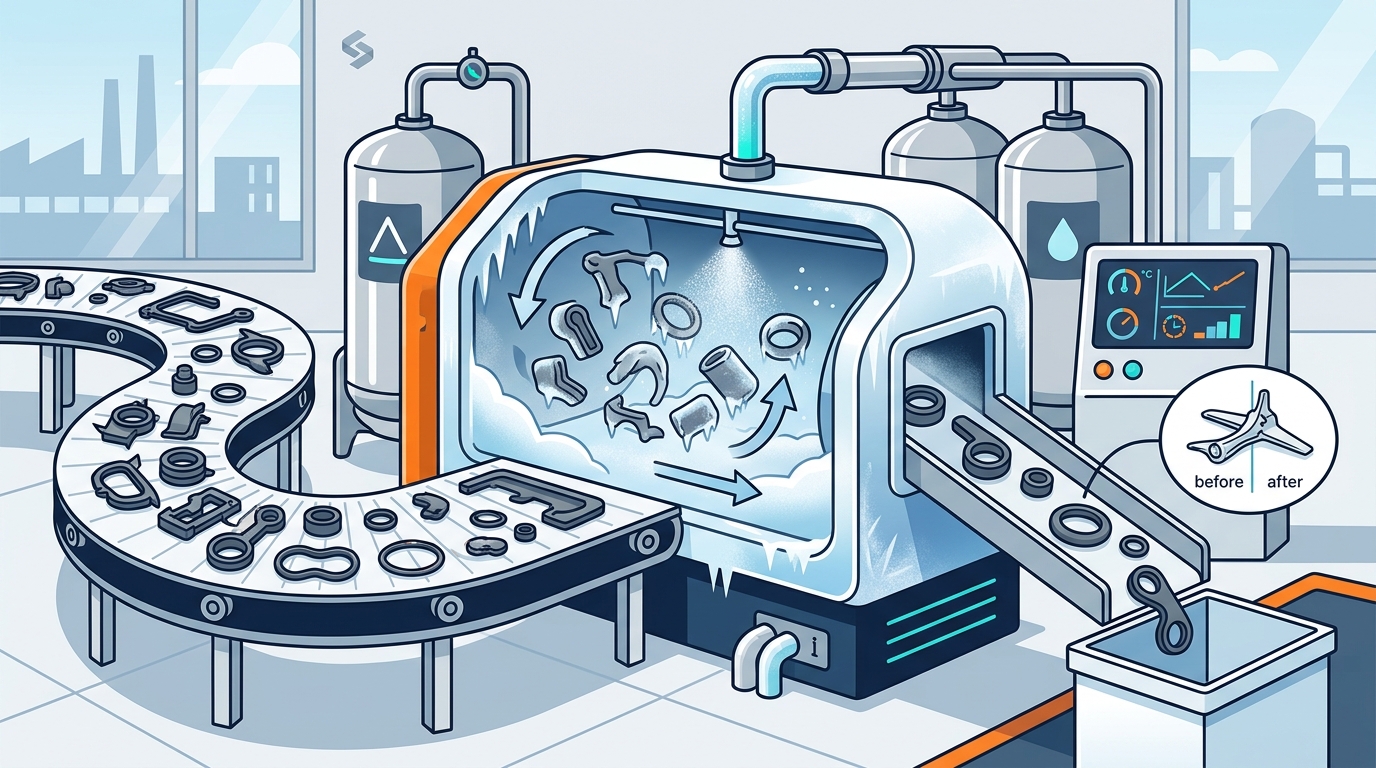
The first critical step in the cryogenic deflashing process is the preparation and freezing of the rubber components. This phase determines the success of the entire operation, as the degree of embrittlement directly influences the efficiency of flash removal. The parts are loaded into a cryogenic chamber where they are exposed to liquid nitrogen or other cryogenic fluids.
The temperature within the chamber is typically lowered to around -100°C to -120°C. At these temperatures, the rubber molecules lose their elasticity and become rigid. Synco Industries' advanced infrastructure ensures that this cooling process is uniform across all parts in the batch, preventing hot spots that could leave some flash intact. The duration of the freezing cycle depends on the mass and material composition of the parts, but it is carefully controlled to avoid over-freezing, which can make the base material too brittle and prone to cracking.
During this phase, the parts are often tumbled gently to ensure even exposure to the cold environment. This step is crucial for complex geometries where some areas might be shielded from the direct flow of cold gas or liquid. Proper preparation ensures that every part reaches the necessary thermal equilibrium before entering the blasting stage.
The Abrasive Impact Process
Once the parts are sufficiently embrittled, they are transferred to the blasting chamber. Here, they are subjected to a high-velocity stream of abrasive media. The media used in cryogenic deflashing is typically kept at cryogenic temperatures to maintain the brittleness of the rubber during the impact. Common media include plastic beads, glass beads, or specialized cryogenic abrasives.
The abrasive particles strike the parts with enough force to shatter the brittle flash, while the base material, though also cold, retains enough toughness to withstand the impact without damage. This selective removal is the core advantage of the cryogenic method. The shot blasting technology principles are adapted here to handle the delicate nature of rubber, ensuring that the surface finish is smooth and free of scratches.
The pressure and velocity of the abrasive stream are adjustable parameters that allow operators to fine-tune the process for different part types. For delicate seals, lower pressure is used to prevent any risk of deformation. For heavier components, higher pressure ensures efficient flash removal. Synco Industries designs its machines with precise control systems to manage these variables, ensuring repeatable results.
Media Separation and Recovery
After the blasting cycle is complete, the parts and the abrasive media are discharged into a separation system. This stage is vital for both cost efficiency and environmental compliance. The system uses air classification and sieving to separate the media from the parts and the removed flash debris.
The abrasive media is cleaned and recycled back into the blasting chamber, reducing operational costs and waste. The flash debris is collected as waste, which is significantly less in volume compared to waste from mechanical deflashing methods. This efficiency is a key selling point for manufacturers looking to reduce their environmental footprint. Synco Industries' deflashing machines are equipped with robust separation units that ensure minimal media loss and high purity of the recycled media.
The recovered media is inspected for wear and tear, and any degraded particles are removed to maintain the quality of the blasting process. This continuous loop of media usage ensures consistent performance over time. The separation system is designed to be easy to maintain, with accessible filters and screens that can be cleaned quickly during production shifts.
Post-Processing and Inspection
The final step in the cryogenic deflashing process is the post-processing and inspection of the parts. Once the media is removed, the parts are allowed to warm up to room temperature. During this warming phase, the rubber regains its elasticity and flexibility. Any remaining flash or debris is typically removed through a secondary air blow or gentle tumbling.
Inspection is critical to ensure that the deflashing process has met the required quality standards. Parts are checked for surface finish, dimensional accuracy, and the absence of any damage. Synco Industries emphasizes the importance of quality assurance in every step of the manufacturing process, and this extends to the performance of their deflashing machines. The machines are designed to minimize the risk of part damage, but regular inspection of the output is still necessary to catch any anomalies early.
Many manufacturers integrate automated vision systems to inspect parts after deflashing. These systems can detect even minor defects that might be missed by human inspectors. The data from these inspections can be used to adjust the deflashing parameters in real-time, ensuring continuous improvement in the process. This level of control is essential for high-volume production environments where consistency is key.
Equipment Selection Guide
Choosing the right cryogenic deflashing equipment is crucial for achieving optimal results. The selection depends on factors such as part size, material type, production volume, and budget. Below is a comparison of common deflashing methods to help you make an informed decision.
| Method | Best For | Pros | Cons |
|---|---|---|---|
| Cryogenic Deflashing | Complex geometries, delicate parts | No damage to base material, consistent finish | Higher initial cost, requires cryogenic fluids |
| Mechanical Tumbling | Simple shapes, high volume | Lower cost, simple operation | Risk of part damage, inconsistent finish |
| Manual Deflashing | Low volume, prototypes | Flexible, no equipment needed | Labor intensive, inconsistent quality |
| Shot Blasting | Heavy-duty surface prep | Fast, durable | Not suitable for delicate rubber |
Synco Industries offers a range of deflashing machines tailored to different industrial needs. Their Cryogenic Deflashing Machines are designed for precision and reliability, making them ideal for automotive and aerospace applications. The company also provides Shot Blasting Machines for more robust surface preparation tasks, ensuring a comprehensive solution for all your surface finishing requirements.
Key Takeaways
- Cryogenic deflashing embrittles rubber flash at -100°C to -120°C for safe removal.
- The process preserves the dimensional accuracy of complex rubber components.
- Synco Industries has over 30 years of experience in precision engineering.
- Automated media recovery reduces operational costs and waste.
- The method is superior to manual deflashing for consistency and quality.
- Synco serves major clients including ISRO and the Indian Navy.
- ISO certification ensures high-quality standards in all Synco products.
Frequently Asked Questions
What is the optimal temperature for cryogenic deflashing?
The optimal temperature is typically between -100°C and -120°C, depending on the rubber compound. This range ensures sufficient embrittlement without damaging the base material.
Can cryogenic deflashing be used for all types of rubber?
Yes, it is effective for most elastomers, including silicone, nitrile, and EPDM. However, the freezing time and media type may need adjustment for different materials.
How does Synco Industries ensure quality in its deflashing machines?
Synco Industries uses robust quality control processes and engages third-party inspectors. Their machines are CE certified and built to ISO standards.
What is the lifespan of the abrasive media used in cryogenic deflashing?
The lifespan varies based on the media type and usage, but Synco's separation systems maximize recovery, extending the life of the media significantly.
Is cryogenic deflashing environmentally friendly?
Yes, it generates less waste than mechanical methods and uses recyclable media. The cryogenic fluids used are typically nitrogen, which is abundant and non-toxic.
How long does the freezing cycle take?
The freezing cycle duration depends on the part size and mass, but it is generally controlled to ensure uniform cooling without over-freezing.
What industries benefit most from cryogenic deflashing?
Automotive, aerospace, and medical device manufacturing are the primary beneficiaries due to their need for high-precision and flawless surfaces.
Does Synco Industries provide after-sales support?
Yes, Synco offers 24/7 support and maintains a ready stock of spare parts to ensure minimal downtime for their clients.
Contact Synco Industries
Ready to upgrade your rubber manufacturing process with precision cryogenic deflashing? Synco Industries provides tailored solutions for your specific production needs. Contact us today to discuss your requirements and receive a free quote. Visit our contact page or call us at +91 9829422258 to speak with our engineering team.