
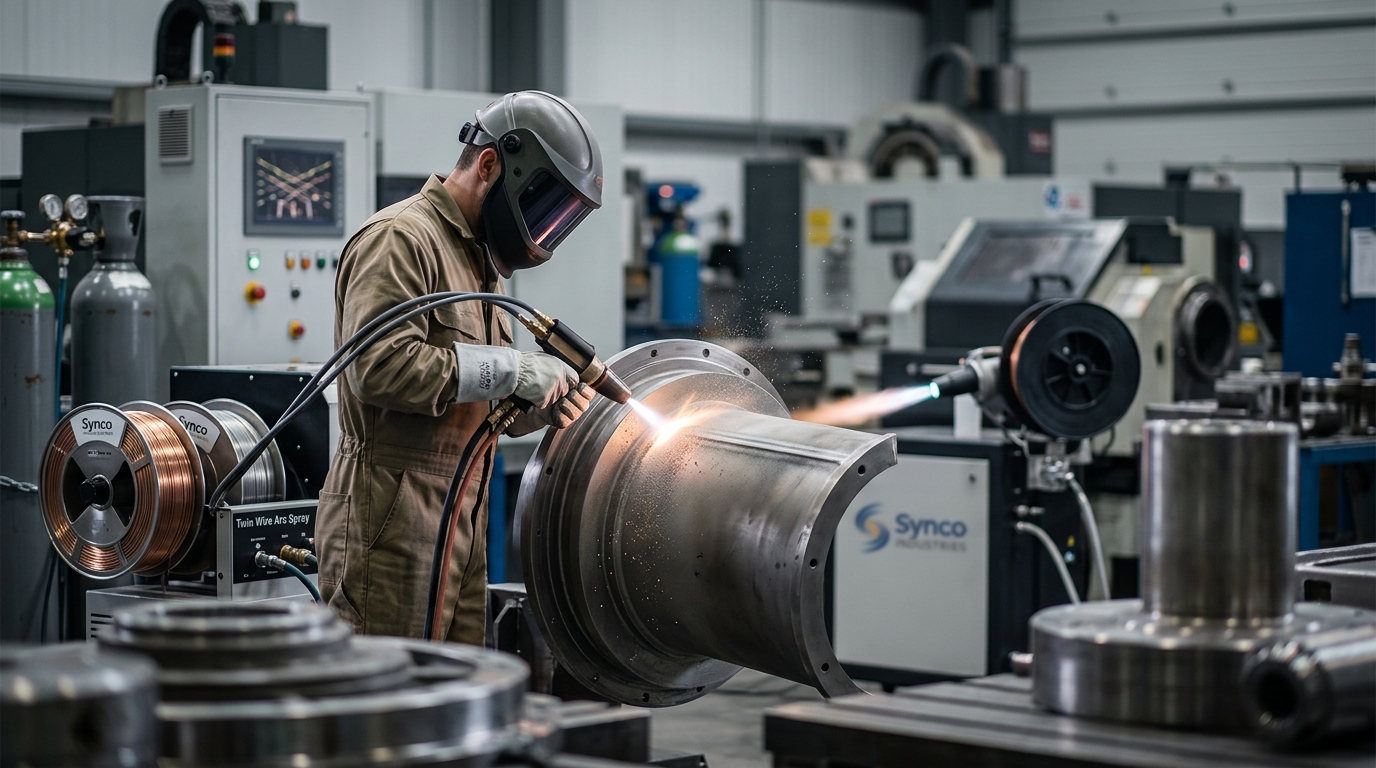
Industrial surface engineering demands precision that standard manufacturing processes cannot always deliver. According to recent metallurgical studies, thermal spray coatings can extend the service life of critical infrastructure components by up to 300 percent compared to untreated materials. This dramatic increase in durability makes the selection of the correct thermal spray technology a decisive factor in operational efficiency. Synco Industries has provided these advanced surface finishing solutions since 1982, serving clients like ISRO and the Indian Navy with high-reliability equipment. (Contact Us 8211 Synco)
Understanding Arc Spray Mechanics
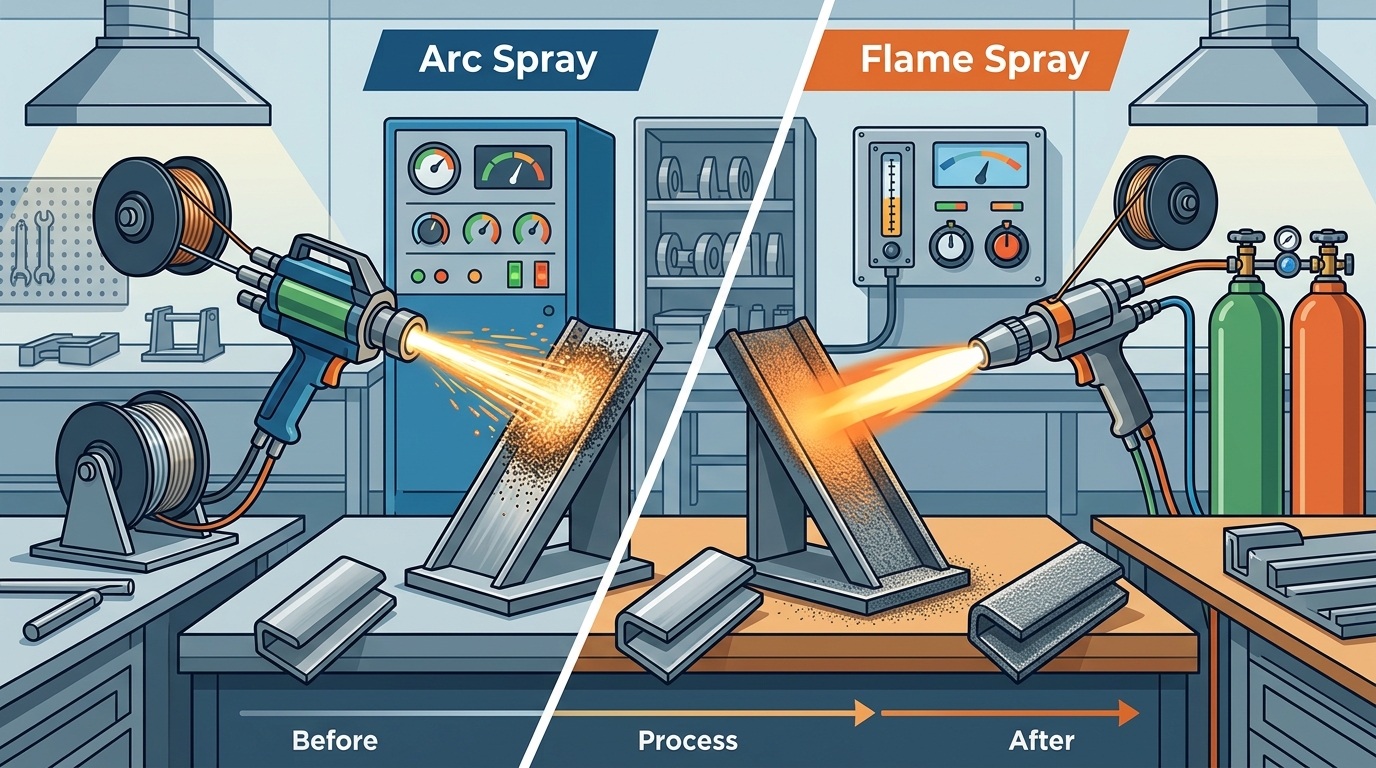
Arc spray thermal coating is a process where two consumable wire electrodes are fed into a gun head. When the tips touch, an electric arc is formed. This arc melts the wire tips, and compressed air atomizes the molten metal, propelling it toward the substrate. The resulting coating is dense and adheres strongly to properly prepared surfaces. (Contact Us 8211 Synco)
Arc Spray is a high-deposition-rate thermal spray process that utilizes electrical energy to melt consumable wires for rapid coating application. This method is particularly effective for large surface areas where speed is a priority. Synco Industries offers the S5k Flame Spray System and Arc Jet System to meet diverse industrial needs. The Arc Jet System is engineered for consistent results and long operational life in demanding environments. (About Us 8211 Synco)
The efficiency of arc spraying comes from its ability to deposit material quickly. This reduces the overall time required for surface preparation and coating application. It is widely used in industries such as automotive, foundry, and structural steel fabrication. The technology allows for the use of a wide variety of metallic materials, including aluminum, zinc, and stainless steel. (About Us 8211 Synco)
Understanding Flame Spray Mechanics
Flame spray thermal coating relies on the combustion of fuel gases, such as acetylene or propane, mixed with oxygen. The resulting flame heats the coating material, which can be in wire or powder form. The heated material is then accelerated toward the workpiece by compressed air.
Flame Spray is a thermal spray process that uses a combustion flame to melt coating materials, offering versatility in material selection and equipment simplicity. Synco Industries provides advanced Flame Spray Systems that are designed for precision and reliability. These systems are ideal for applications where the substrate cannot withstand the higher temperatures associated with other thermal spray methods.
The flame spray process is known for its flexibility. It can be used for both wire and powder feedstocks, allowing engineers to choose the material that best suits the application. The equipment is generally less complex than arc spray systems, which can simplify maintenance and operation. However, the deposition rate is typically lower than that of arc spraying.
Key Differences in Application
Choosing between arc spray and flame spray depends on several factors, including the desired coating thickness, material compatibility, and production volume. Arc spray is generally faster and more efficient for large-scale operations. Flame spray offers greater control over the heat input, which is crucial for heat-sensitive substrates.
The bond strength of arc spray coatings is often superior due to the high velocity of the particles. Flame spray coatings may have higher porosity, which can be beneficial for certain lubrication applications but detrimental for corrosion protection. The choice of system also impacts the operational costs, with arc spray typically having lower operating costs per square foot due to higher deposition rates.
Step-by-Step Arc Spray Application
Proper application of arc spray coatings requires meticulous preparation and execution. The following steps outline the standard procedure for achieving a high-quality finish.
Step 1: Surface Preparation
The substrate must be clean and roughened to ensure proper adhesion. Abrasive blasting is the standard method for preparing the surface. Synco Industries manufactures specialized Shot Blasting Machines to achieve the required surface profile. The surface should be free of oil, grease, and contaminants.
Step 2: Equipment Setup
Install the appropriate wire electrodes into the Arc Jet System. Ensure that the air pressure and electrical settings are calibrated according to the material specifications. Verify that the grounding clamp is securely attached to the workpiece.
Step 3: Spray Execution
Initiate the arc and begin spraying. Maintain a consistent distance between the gun and the substrate, typically between 6 and 12 inches. Move the gun at a steady speed to ensure uniform coating thickness. Overlap each pass by approximately 50 percent to avoid gaps in the coating.
Step 4: Post-Processing
Allow the coated part to cool slowly to prevent thermal shock. Inspect the coating for defects such as porosity or inclusions. Machining or grinding may be required to achieve the final dimensional tolerances.
Step-by-Step Flame Spray Application
Flame spray application follows a similar preparation protocol but differs in the spraying technique and equipment handling.
Step 1: Surface Preparation
As with arc spray, surface preparation is critical. Use abrasive blasting to create a suitable anchor pattern. The surface must be clean and dry before proceeding.
Step 2: Gas and Material Setup
Connect the fuel gas and oxygen lines to the Flame Spray System. Load the wire or powder feedstock into the gun. Adjust the gas flow rates to achieve the correct flame temperature and character.
Step 3: Spray Execution
Ignite the flame and adjust the air pressure to atomize the material. Hold the gun perpendicular to the surface. Move the gun steadily across the substrate, maintaining a consistent distance. The operator must monitor the flame color to ensure proper combustion.
Step 4: Quality Control
Inspect the coating for uniformity and adhesion. Flame spray coatings may require sealing to reduce porosity, especially in corrosive environments. Synco Industries provides comprehensive support and spare parts to maintain equipment performance.
Comparative Analysis of Systems
The table below summarizes the key differences between Arc Spray and Flame Spray systems to assist in decision-making.
| Feature | Arc Spray System | Flame Spray System |
|---|---|---|
| Power Source | Electrical Arc | Combustion Flame |
| Deposition Rate | High | Moderate |
| Material Form | Wire Only | Wire or Powder |
| Heat Input | Higher | Lower |
| Operational Cost | Lower per unit area | Higher per unit area |
| Best For | Large surfaces, corrosion protection | Heat-sensitive parts, specialized alloys |
Understanding these differences is essential for selecting the right equipment. Synco Industries offers customized solutions to match specific industry applications and production needs. Their expertise in precision engineering ensures that clients receive systems that deliver uniform cleaning, descaling, and surface strengthening.
Key Takeaways
- Synco Industries was established in 1982 and has over 30 years of experience in industrial manufacturing.
- The company serves more than 1000 clients globally, including major organizations like ISRO and the Indian Navy.
- Arc spray offers a higher deposition rate, making it ideal for large-scale industrial applications.
- Flame spray provides lower heat input, which is critical for coating heat-sensitive substrates.
- Synco's Arc Jet System and S5k Flame Spray System are designed for consistent results and long operational life.
- Proper surface preparation using shot blasting is the most critical step in any thermal spray application.
- Synco Industries provides 24/7 support and ready spare parts availability for all its machines.
Frequently Asked Questions
What is the primary difference between arc spray and flame spray?
Arc spray uses an electric arc to melt wire electrodes, while flame spray uses a combustion flame to melt wire or powder. Arc spray generally offers a higher deposition rate.
Which system is better for corrosion protection?
Arc spray is often preferred for corrosion protection because it can deposit thick layers of zinc or aluminum quickly and efficiently. The dense coating provides excellent barrier protection.
Can Synco Industries provide customized thermal spray solutions?
Yes, Synco Industries specializes in customized solutions tailored to specific production needs, component size, and material type. They develop tailor-made machines to match industry applications.
What materials can be used with flame spray?
Flame spray can utilize both wire and powder feedstocks. This includes metals, alloys, and ceramics, offering greater versatility in material selection compared to arc spray.
How does Synco ensure the quality of its thermal spray equipment?
Synco Industries ensures quality through robust quality control processes and third-party inspections. Their machines are CE certified, and the company holds ISO certification for its quality management systems.
What industries benefit most from thermal spray coatings?
Industries such as automotive, foundry, structural steel, heavy fabrication, and infrastructure benefit significantly. The coatings enhance durability, reduce wear, and extend component life.
Does Synco offer support for their thermal spray systems?
Synco provides a strong service network with prompt service and 24/7 support. They also maintain ready spare parts availability to minimize downtime for their clients.
Contact Synco Industries
Investing in the right thermal spray technology is crucial for maintaining industrial excellence. Synco Industries offers a comprehensive range of products, including Shot Blasting Machines, Thermal Spray Equipments, and Deflashing Machines. Their commitment to precision engineering and customer satisfaction makes them a trusted partner for surface finishing requirements.
For more information on their Arc Jet System or S5k Flame Spray System, visit their official website or contact their team directly. They provide free quotes and expert guidance to help you select the best solution for your production needs. Explore their product range to discover how their equipment can enhance your operational efficiency.