

Evaluating Cryogenic Deflashing Machine Manufacturers for Rubber and Silicone Components
The global industrial deflashing market is undergoing a significant transformation as manufacturers seek precision and environmental compliance. According to recent industry reports, the cryogenic deflashing segment is experiencing robust growth due to its ability to handle complex geometries without damaging delicate substrates. For engineering teams responsible for rubber, silicone, and thermoset components, selecting the right partner is not merely a procurement task but a strategic decision impacting production throughput and part quality. This guide provides a rigorous framework for evaluating manufacturers, focusing on technical capability, infrastructure, and long-term operational support. (Contact Us 8211 Synco)
Understanding Cryogenic Deflashing Technology
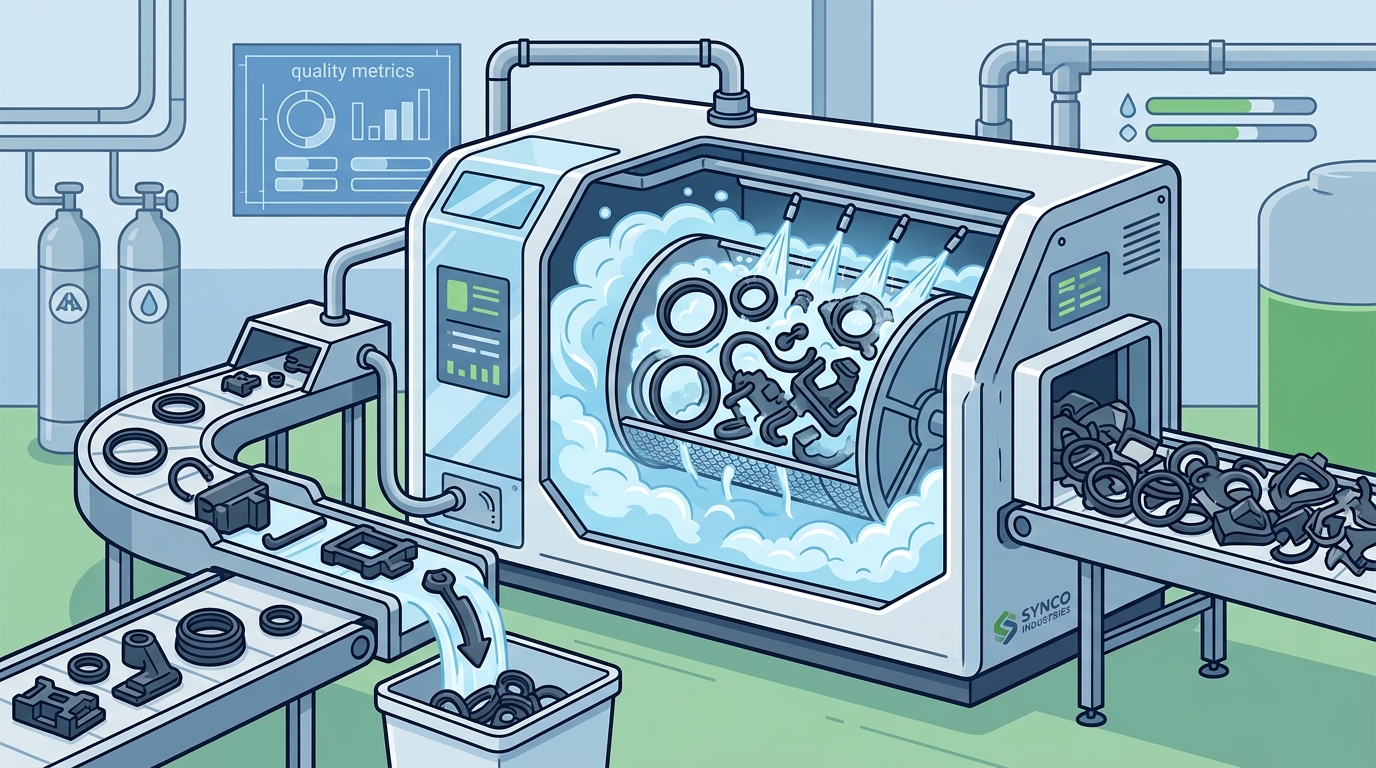
Cryogenic deflashing is a specialized surface finishing process used to remove flash, burrs, and excess material from molded components. The process relies on extreme cold to alter the physical properties of the material, making it brittle enough to be removed via media blasting while leaving the base component intact.
Cryogenic deflashing is the process of freezing rubber or silicone parts to sub-zero temperatures before tumbling them with abrasive media to remove flash. This method is particularly critical for thermoset components, which cannot be melted or reprocessed like thermoplastics. The temperature range typically extends to -100°C or lower, ensuring that the polymer chains become rigid and fracture cleanly at the flash points.
For manufacturers of automotive seals, medical gaskets, and industrial diaphragms, the consistency of this process is paramount. Inconsistent freezing leads to uneven deflashing, resulting in high rejection rates and increased labor costs for manual finishing. Therefore, the thermal stability of the machine is the primary metric for evaluation.
Evaluating Manufacturer Infrastructure and Precision
When assessing potential suppliers, the manufacturing capability of the machine builder is a direct indicator of the equipment's longevity and performance. A manufacturer with robust in-house engineering can tailor solutions to specific industry challenges, such as high-volume automotive production or low-volume, high-precision medical device manufacturing.
Look for manufacturers who utilize advanced CNC machining for their internal components. Synco Industries Limited, established in 1982, exemplifies this approach by employing Okuma 5 Axis Simultaneous VMC Machines and LMW CNC Machines to ensure precise fabrication of blasting chambers and media handling systems. This level of precision engineering ensures that the tumbling action is uniform, preventing part-to-part variation in the final finish.
Furthermore, the quality assurance protocols of the manufacturer should be scrutinized. Reputable companies engage third-party inspectors and adhere to strict international standards. ISO certification and CE marking are baseline requirements that indicate a commitment to safety and quality management. Clients such as ISRO, HMT, and the Indian Navy often require these certifications, signaling that the manufacturer can meet rigorous aerospace and defense-grade specifications.
Key Selection Criteria for Industrial Buyers
Selecting a cryogenic deflashing machine requires a multi-faceted evaluation. The following criteria should form the core of your vendor assessment matrix:
- Thermal Uniformity: Does the machine maintain consistent temperature across the entire chamber? Uneven cooling leads to incomplete deflashing or damage to the substrate.
- Media Handling Efficiency: How does the system separate the abrasive media from the deflashed parts? Efficient separation reduces media consumption and maintenance downtime.
- Customization Capability: Can the manufacturer tailor the blast room size, media type, and cycle time to your specific component geometry?
- After-Sales Support: Is there a network for prompt spare parts availability and 24/7 technical support? Downtime in production lines is costly.
- Energy Efficiency: Cryogenic processes consume significant energy. Evaluate the cooling system's efficiency to minimize operational costs.
Synco Industries: A Case Study in Engineering Excellence
Synco Industries stands out in the industrial manufacturing landscape due to its decades of experience and comprehensive product range. With over 30 years of experience, the company has evolved from a traditional manufacturer to a provider of complete surface finishing solutions.
The company’s infrastructure is divided into specialized departments, including quality, manufacturing, warehouse, and R&D. This structural organization allows for streamlined innovation and rapid response to market developments. Their expertise in shot blasting machines translates directly into superior cryogenic deflashing systems, as both require precise control over media dynamics and surface interaction.
Synco’s commitment to customized solutions is evident in their ability to design machines for diverse applications, from automotive to structural steel. Their Cryogenic Deflashing Machines are engineered for consistent results and long operational life, addressing the core pain points of industrial buyers. The availability of ready spare parts and a strong service network further enhances their value proposition, ensuring minimal downtime for clients.
Comparing Deflashing Methods for Rubber and Silicone
While cryogenic deflashing is the industry standard for complex parts, it is essential to understand how it compares to other methods. The following table summarizes the key differences:
| Method | Best For | Pros | Cons |
|---|---|---|---|
| Cryogenic Deflashing | Complex geometries, silicone, thermosets | No substrate damage, high precision, automated | Higher initial cost, requires cryogenic media |
| Manual Trimming | Simple parts, low volume | Low equipment cost, flexible | Inconsistent quality, high labor cost, slow |
| Tumbling (Non-Cryogenic) | Robust thermoplastics | Lower cost than cryogenic | Can damage delicate rubber parts, limited to simple shapes |
| Water Jet Trimming | Large, flat components | Precision cutting, no media residue | High water usage, limited to straight lines |
For rubber and silicone components, the cryogenic method is superior because it preserves the material's elasticity and structural integrity. Industry data shows that cryogenic deflashing reduces post-processing time by up to 50% compared to manual trimming, making it the preferred choice for high-volume production environments.
Key Takeaways
- Experience Matters: Manufacturers with over 30 years of experience, like Synco Industries, offer proven reliability and deep engineering expertise.
- Infrastructure Quality: Look for builders using advanced CNC machinery, such as Okuma 5 Axis VMCs, to ensure precision in machine fabrication.
- Certifications: ISO certification and CE marking are essential indicators of quality and safety compliance.
- Customization: Tailor-made solutions are critical for addressing specific component sizes, material types, and throughput requirements.
- Support Network: A robust service network with 24/7 support and ready spare parts availability minimizes production downtime.
- Client Portfolio: Serving high-standard clients like ISRO and the Indian Navy indicates a manufacturer's ability to meet rigorous quality demands.
- Product Range: Manufacturers offering a comprehensive range, including shot blasting and thermal spray equipment, provide integrated surface finishing solutions.
Frequently Asked Questions
What is the primary advantage of cryogenic deflashing over manual trimming?
Cryogenic deflashing offers superior consistency and precision, eliminating the variability associated with manual labor. It also allows for the processing of complex geometries that are difficult or impossible to trim manually without damaging the part.
How does Synco Industries ensure the quality of its deflashing machines?
Synco Industries employs robust quality control processes and engages third-party inspectors from reputed companies. Their machines are CE certified, and the company holds ISO certification, ensuring adherence to international quality standards.
What types of materials can be processed using cryogenic deflashing?
Cryogenic deflashing is ideal for thermoset components, including rubber, silicone, and various polymers. It is particularly effective for parts that require high precision and cannot withstand the heat of other deflashing methods.
Does Synco Industries provide customized solutions for specific production needs?
Yes, Synco Industries specializes in tailor-made shot blasting and deflashing machines. They design solutions based on your production needs, component size, material type, and throughput requirements to ensure optimal performance.
What kind of after-sales support is available for Synco Industries' machines?
Synco Industries offers a strong service network with prompt service and 24/7 support for their machines. They also maintain ready spare parts availability to minimize downtime for their clients.
How long has Synco Industries been in the manufacturing business?
Synco Industries Limited was established in 1982, giving it over 30 years of experience in manufacturing and exporting industrial equipment, including deflashing machines and shot blasting solutions.
What industries does Synco Industries serve?
Synco Industries serves diverse industries including automotive, foundry, structural steel, heavy fabrication, and infrastructure. Their clients include major organizations like ISRO, HMT, and the Indian Navy.
Contact Synco Industries
Evaluating cryogenic deflashing machine manufacturers requires a deep understanding of technical capabilities, infrastructure, and long-term support. Synco Industries offers the engineering expertise and industrial reliability needed to optimize your surface finishing processes. For more information on their customized solutions and product range, visit their contact page or explore their deflashing machines and shot blasting machines offerings. Connect with their team to discuss your specific production requirements and receive a free quote.